

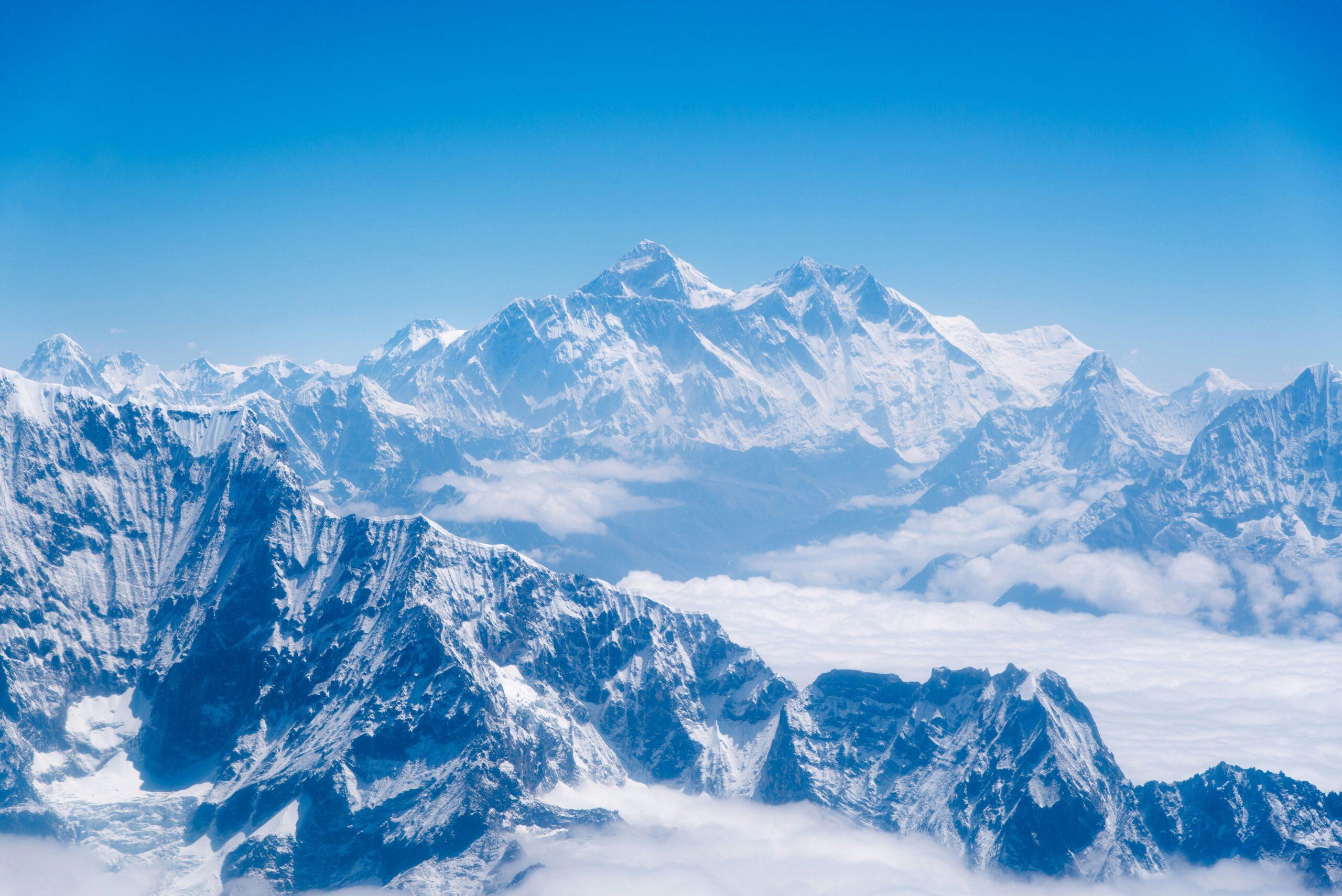
Mount Everest Expedition
$ 49,500.00$ 46,000.00
The Mount Everest Expedition is the journey to conquer the ultimate high-altitude mountaineering endeavor, the highest mountain range in the world, Sagarmatha in Nepal/Chomolungma in Tibet, and the English name Mount Everest (8,848.86 m above sea level). First successfully ascended by Sir Edmund Hillary and Tenzing Norgay Sherpa on May 29, 1953, Mount Everest is the ultimate symbol of adventure and human determination.
And the Mount Everest climbing itinerary of 60 days via the South Col route, following in the footsteps of the legendary climbers, is designed so that the Everest expedition success rate is high. One of the greatest feats a mountaineer can undertake, it is why, before attempting to climb Mount Everest, one must have experience conquering 6,000 m and 7,000 m peaks, such as Island Peak Climbing, Mera Peak Climbing,Ama Dablam Expedition.
Located within the Everest trekking and climbing regions, climbing these may help in better conditioning, or you may choose your local climbing routes. Either way, climbing Everest is recommended only to seasoned climbers and daredevils with unwavering dedication and preparation. With our remarkable 100% success rate, 6 climbers and 6 Sherpas standing triumphant on the summit, we strive to make your expedition hassle-free.
Product Description
Mount Everest Expedition: Cost, Itinerary, Difficulty & Complete Guide
The Mount Everest Expedition is the ultimate high-altitude mountaineering adventure and one of the most prestigious climbing achievements in the world. Rising to 8,848.86 meters (29,031.69 feet) above sea level, Mount Everest is the highest mountain on Earth.
Located in the Himalayas on the border between Nepal and Tibet, Everest attracts experienced mountaineers from around the world who dream of standing on the highest point on the planet.
A Mount Everest Expedition from Nepal typically follows the classic South Col route through the Khumbu region. The journey begins with a flight from Kathmandu to Lukla, followed by a gradual trek through Namche Bazaar, Tengboche, Dingboche and Lobuche before reaching Everest Base Camp at approximately 5,364 meters (17,598 feet).
From Base Camp, climbers spend several weeks acclimatizing and making rotations through Camp I, Camp II and Camp III before preparing for the final summit push through Camp IV and the South Col.
Current commercial Everest programs commonly run for approximately 50–53 days, although expedition duration varies according to the operator, acclimatization strategy, weather conditions and services provided. Current 2026 programs published by Seven Summit Treks, for example, list 50-day and 53-day Everest expedition programs.
Mount Everest Expedition Highlights
- Mountain: Mount Everest
- Elevation: 8,848.86 m / 29,031.69 ft
- World ranking: Highest mountain in the world
- Location: Nepal–Tibet border
- Nepal climbing route: South Col / Southeast Ridge
- Region: Khumbu, Nepal
- First ascent: 1953
- First summiters: Sir Edmund Hillary and Tenzing Norgay
- Expedition duration: Approximately 50–53 days
- Everest Base Camp: 5,364 m
- Camp I: Approximately 6,065 m
- Camp II: Approximately 6,400 m
- Camp III: Approximately 7,200–7,400 m
- Camp IV / South Col: Approximately 7,900–8,000 m
- Summit: 8,848.86 m
- Best climbing season: Spring
- Other climbing season: Autumn
- Difficulty: Extreme
- Climbing style: High-altitude expedition
Current commercial programs use the South Col and Southeast Ridge route from Nepal, with climbing rotations through Camps I–III followed by the final summit period through Camp IV.
What Is the Mount Everest Expedition?
The Mount Everest Expedition is a full-scale mountaineering expedition to the summit of Mount Everest, the world’s highest mountain.
Unlike the Everest Base Camp Trek, an Everest expedition involves climbing from Base Camp through the Khumbu Icefall and higher camps before reaching the summit.
The expedition requires:
- Advanced mountaineering skills
- High-altitude experience
- Technical climbing ability
- Exceptional physical endurance
- Acclimatization
- Specialized equipment
- High-altitude Sherpa support
- Supplemental oxygen for many climbers
- Professional expedition logistics
The standard commercial route from Nepal follows the historic South Col route.
The journey begins in Kathmandu and continues to Lukla before following the classic Everest trekking route through the Khumbu Valley.
Why Climb Mount Everest?
1. Stand on the Highest Point on Earth
At 8,848.86 meters, Everest is the highest mountain in the world.
Reaching its summit is one of the most recognized achievements in mountaineering.
2. Experience the Legendary Khumbu
The expedition takes you through the heart of Nepal’s Khumbu region.
Along the approach, climbers experience:
- Sherpa villages
- Buddhist monasteries
- Rhododendron forests
- Glacial valleys
- High Himalayan landscapes
- Ama Dablam views
- Lhotse and Nuptse
- Everest itself
3. Follow a Historic Mountaineering Route
The South Col route has a remarkable history.
Sir Edmund Hillary and Tenzing Norgay made the first confirmed successful ascent of Everest in 1953.
Today, the route remains one of the world’s most famous high-altitude climbing routes.
4. Challenge Yourself at Extreme Altitude
Everest exposes climbers to the extreme environment above 8,000 meters, where oxygen availability is dramatically reduced.
5. Complete an Extraordinary Mountaineering Achievement
An Everest summit is the culmination of months or years of preparation, training, experience and expedition planning.
Mount Everest Expedition Cost
The Mount Everest Expedition cost varies significantly depending on the expedition operator and level of service.
A basic commercial expedition, premium expedition and VIP/VVIP expedition can have dramatically different prices.
Major factors affecting Everest Expedition cost include:
- Everest climbing permit
- Government royalty
- Sagarmatha National Park fees
- Local municipality fees
- Liaison officer
- Garbage-management deposit
- Domestic flights
- Helicopter transportation
- Accommodation
- Food
- Base Camp services
- Climbing Sherpa support
- High-altitude Sherpa support
- Supplemental oxygen
- Oxygen masks
- Oxygen regulators
- Fixed ropes
- Expedition equipment
- Communication systems
- Medical support
- Insurance
- Emergency evacuation
The Nepal government’s current Everest climbing royalty for foreign climbers on the normal route is:
| Season | Everest Royalty |
|---|---|
| Spring | US$15,000 |
| Autumn | US$7,500 |
| Winter/Summer | US$3,750 |
These rates took effect on September 1, 2025.
The Everest garbage-management deposit is currently US$4,000 per expedition team under the Department of Tourism’s published provisions.
The climbing royalty is only one part of the total cost.
What Does an Everest Expedition Cost?
A realistic commercial budget can range widely depending on the level of support.
Premium and fully supported expeditions can cost tens of thousands of US dollars, while VIP/VVIP services can be substantially more expensive.
For example, current commercial programs offer different levels of service, including classic and premium/VIP expedition packages.
Always compare what is included rather than choosing an expedition solely on the advertised price.
Mount Everest Expedition Package
A professional Everest Expedition package may include:
Accommodation
- Kathmandu hotel
- Lukla accommodation
- Teahouse/lodge accommodation during the approach
- Everest Base Camp tents
- High-altitude tents
Transportation
- Airport transfers
- Kathmandu–Lukla flight
- Lukla–Kathmandu flight
- Ground transportation
- Helicopter services where included
Trekking Support
- Trekking guide
- Porters
- Kitchen staff
- Base Camp staff
Climbing Support
- Experienced climbing Sherpas
- High-altitude Sherpas
- Fixed-rope support
- Camp establishment
- Summit logistics
- Route preparation
Permits and Government Fees
Depending on the package:
- Everest climbing permit
- Sagarmatha National Park permit
- Local government fees
- Liaison officer
- Garbage-management arrangements
Current commercial Everest packages explicitly include government expedition royalty/permit fees along with Sagarmatha National Park and Pasang Lhamu Rural Municipality fees.
Mount Everest Expedition Itinerary
A typical Mount Everest Expedition itinerary from Nepal takes approximately 50–53 days.
The exact itinerary varies according to weather, acclimatization, route conditions and the expedition operator.
Below is a representative itinerary based on current commercial expedition structures.
Day 1: Arrival in Kathmandu
Arrive in Kathmandu and transfer to your hotel.
Meet the expedition team and receive an initial briefing.
Day 2: Expedition Briefing and Preparation
Complete:
- Permit formalities
- Equipment inspection
- Team briefing
- Final preparations
- Expedition planning
Day 3: Fly Kathmandu to Lukla
Fly from Kathmandu to Lukla at approximately 2,860 meters.
Begin the trek toward Phakding.
Day 4: Phakding to Namche Bazaar
Trek through the Dudh Koshi Valley toward Namche Bazaar at approximately 3,440 meters.
Day 5: Acclimatization at Namche
Rest and acclimatize.
Take a short hike to higher elevations and return to Namche.
Day 6: Namche to Tengboche/Deboche
Continue through the Khumbu region with spectacular views of Everest, Ama Dablam and surrounding peaks.
Day 7: Tengboche to Dingboche
Continue toward Dingboche at approximately 4,243 meters.
Day 8: Acclimatization at Dingboche
Rest and acclimatize.
Take a short hike toward higher terrain.
Day 9: Dingboche to Lobuche
Continue toward Lobuche at approximately 4,930 meters.
Day 10: Lobuche to Everest Base Camp
Trek through the Khumbu Glacier region and reach Everest Base Camp at approximately 5,364 meters.
Settle into the expedition camp.
Days 11–20: Base Camp Acclimatization and Training
Spend time at Everest Base Camp preparing for the climbing rotations.
Activities may include:
- Icefall training
- Crampon practice
- Fixed-rope training
- Equipment checks
- Puja ceremony
- Route briefings
- Medical checks
- Weather monitoring
Days 21–30: Acclimatization Rotations
Begin climbing rotations.
A typical rotation may involve:
Base Camp → Camp I → Camp II → Base Camp
A later rotation may extend toward Camp III.
After each rotation, climbers descend to recover.
Days 31–35: Rest and Recovery
Return to Base Camp.
Rest, eat, hydrate and prepare for the summit push.
Days 36–46: Summit Window
The team waits for the appropriate weather window.
The summit push typically follows:
Base Camp → Camp II → Camp III → Camp IV/South Col → Summit
After reaching the summit, climbers descend through the higher camps and return toward Base Camp.
Current commercial itineraries specifically allocate a multi-week climbing period to align the summit push with the best available weather window.
Day 47: Base Camp Cleanup
Remove expedition equipment and participate in Base Camp cleanup.
Days 48–50: Return to Kathmandu
Return through the Khumbu Valley or use helicopter transportation depending on the package.
Final Departure
Transfer to Tribhuvan International Airport for your international flight.
Mount Everest Expedition Route
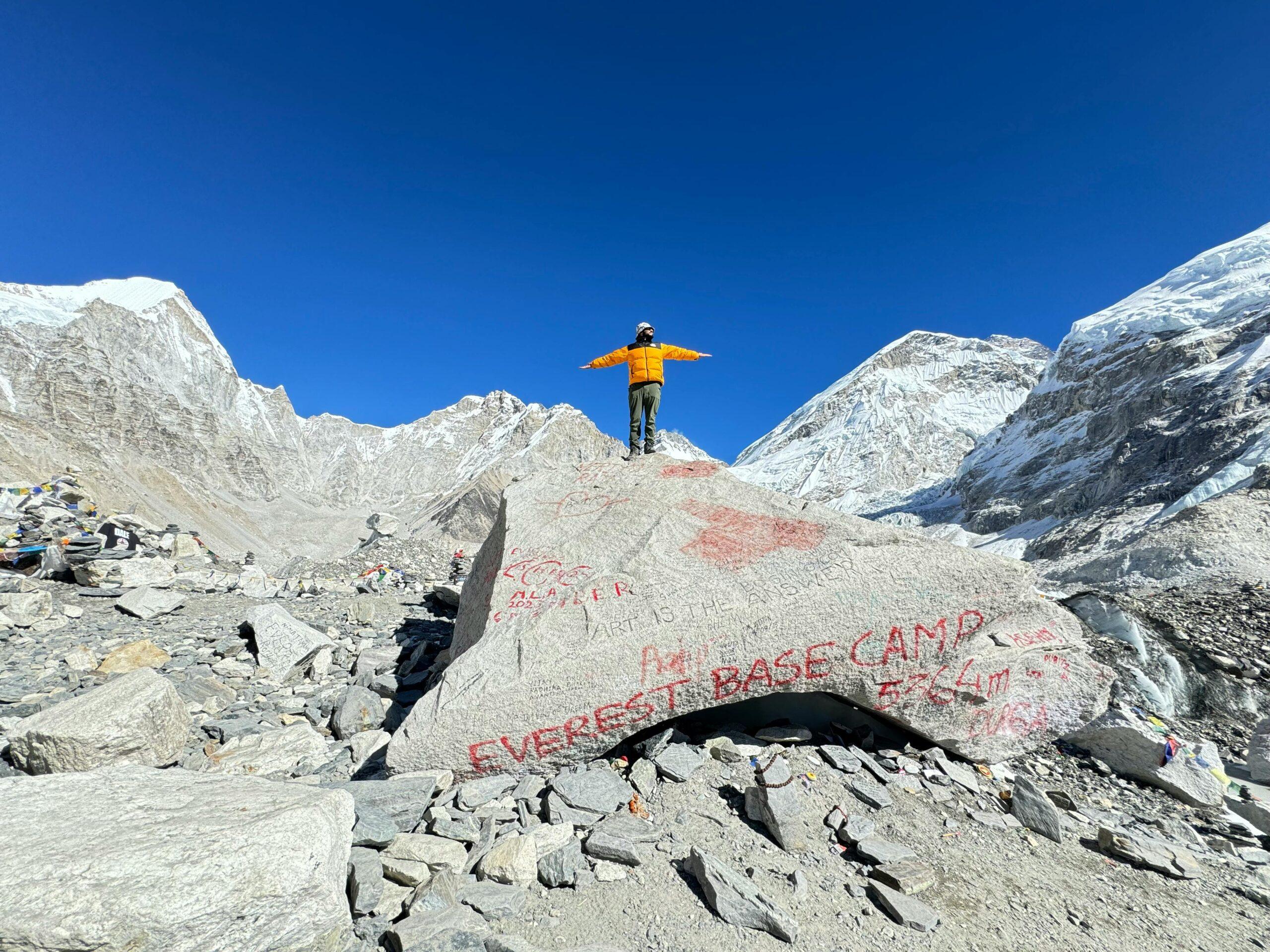
Trekker celebrating on a snowy ridge during the Everest Base Camp Trek
The classic Mount Everest Expedition route from Nepal follows:
Kathmandu → Lukla → Phakding → Namche Bazaar → Tengboche → Dingboche → Lobuche → Everest Base Camp → Khumbu Icefall → Camp I → Camp II → Camp III → Camp IV/South Col → Everest Summit
The route is commonly referred to as the South Col / Southeast Ridge route.
Current commercial Everest expedition programs list the South Col and Southeast Ridge as their route.
Everest Base Camp
Everest Base Camp is located at approximately 5,364 meters (17,598 feet) on the Nepal side.
It becomes the central operational base for the expedition.
A full-service Everest Base Camp can contain:
- Sleeping tents
- Dining tent
- Kitchen
- Communications
- Medical facilities
- Internet/communications where available
- Equipment storage
- Charging facilities
- Toilet facilities
- Weather-monitoring systems
Base Camp is also where climbers spend substantial time acclimatizing before entering the Khumbu Icefall.
Khumbu Icefall
The Khumbu Icefall is one of the most dangerous sections of the South Col route.
Located between Everest Base Camp and Camp I, the Icefall contains:
- Crevasses
- Seracs
- Ice towers
- Ladders
- Fixed ropes
- Unstable glacier terrain
Climbers typically cross the Icefall during the cooler hours when conditions are considered more favorable.
The route through the Icefall changes from season to season.
Experienced Sherpa teams establish and maintain the climbing route.
Everest Camp I
Camp I is located at approximately 6,065 meters in the Western Cwm.
The route from Base Camp passes through the Khumbu Icefall before reaching Camp I.
From Camp I, climbers continue through the Western Cwm toward Camp II.
Everest Camp II
Camp II is generally located around 6,400 meters.
It is positioned in the Western Cwm and serves as an important acclimatization and staging camp.
Climbers typically spend time here during acclimatization rotations before returning to Base Camp.
Everest Camp III
Camp III is located around 7,200–7,400 meters on the Lhotse Face.
The Lhotse Face is a steep wall of blue ice and snow.
Climbers ascend the face using fixed ropes and specialized mountaineering equipment.
Camp III is sometimes called the Advanced Camp or Camp III depending on the expedition terminology.
Everest Camp IV and the South Col
Camp IV, located at approximately 7,900–8,000 meters, is established at the South Col.
This is the final major camp before the summit.
The South Col is often considered the gateway to the summit push.
Climbers typically spend as little time as practical here because the altitude is extremely dangerous.
Everest Summit Day
Summit day is the climax of the expedition.
A typical summit push begins during the night.
The route from Camp IV generally follows:
South Col → Balcony → South Summit → Hillary Step area → Summit
The exact route configuration can change because of route fixing, snow and ice conditions.
The final ascent involves extreme altitude, cold, wind and limited oxygen.
After reaching the summit, climbers must descend immediately and safely.
Standing at 8,848.86 meters is only half the challenge.
The descent is equally important.
Mount Everest Expedition Difficulty
The Mount Everest Expedition difficulty is considered extreme.
Everest should never be treated as an ordinary trekking or climbing trip.
Major challenges include:
- Extreme altitude
- Low oxygen levels
- Khumbu Icefall
- Crevasses
- Seracs
- Lhotse Face
- High winds
- Extreme cold
- Avalanche hazards
- Altitude illness
- Long summit day
- Physical exhaustion
- Crowding and route delays
- Rapidly changing weather
The mountain demands strong technical skills, endurance, judgment and extensive high-altitude experience.
Mount Everest Height and Altitude
Mount Everest stands at:
8,848.86 meters / 29,031.69 feet
It is the highest mountain in the world.
Major elevations on the Everest Expedition
| Location | Approximate Elevation |
|---|---|
| Kathmandu | 1,400 m |
| Lukla | 2,860 m |
| Namche Bazaar | 3,440 m |
| Tengboche | ~3,860 m |
| Dingboche | 4,243 m |
| Lobuche | 4,930 m |
| Everest Base Camp | 5,364 m |
| Camp I | ~6,065 m |
| Camp II | ~6,400 m |
| Camp III | ~7,200–7,400 m |
| Camp IV / South Col | ~7,900–8,000 m |
| Everest Summit | 8,848.86 m |
Current commercial itineraries use these same major route elevations, including Everest Base Camp at 5,364 m and the summit at 8,848.86 m.
Everest Acclimatization
Acclimatization is one of the most important components of an Everest Expedition.
Climbers normally use a series of rotations to gradually expose their bodies to increasing altitude.
A typical progression is:
Rotation 1
Base Camp → Camp I → Camp II → Base Camp
Rotation 2
Base Camp → Camp I → Camp II → Camp III → Base Camp
Final Summit Push
Base Camp → Camp II → Camp III → Camp IV → Summit
The exact strategy depends on the expedition operator, climber’s health, weather and route conditions.
Best Time for Mount Everest Expedition
The principal Everest climbing season from Nepal is spring.
Spring Everest Expedition
The main season generally runs from:
April to May
May is particularly important because teams aim to find suitable summit weather windows.
Spring offers:
- Established expedition activity
- Longer daylight
- Favorable summit-window opportunities
- Extensive route infrastructure
The majority of commercial Everest expeditions operate during the spring season.
Autumn Everest Expedition
Autumn also offers climbing opportunities, although it is less common than the main spring season.
September–October can provide favorable weather windows after the monsoon, depending on the year and route conditions.
Mount Everest Expedition Permits
A climber needs an official Everest climbing permit from the Government of Nepal.
Additional administrative requirements can include:
- Sagarmatha National Park entry
- Pasang Lhamu Rural Municipality fees
- Liaison officer
- Garbage-management deposit
- Expedition registration
- Route documentation
The current Department of Tourism royalty schedule lists the foreign-climber Everest normal-route royalty at US$15,000 in spring, US$7,500 in autumn and US$3,750 in winter/summer.
For Nepalese climbers, the current published normal-route royalty is:
- NPR 150,000 in spring
- NPR 75,000 in autumn
- NPR 37,500 in winter/summer
Government rules and fees can change, so expedition operators should verify the current requirements before departure.
Mount Everest Expedition Equipment
An Everest Expedition requires specialized high-altitude mountaineering equipment.
Personal Climbing Equipment
- 8,000-meter mountaineering boots
- Crampons
- Ice axe
- Climbing harness
- Helmet
- Ascender
- Descender
- Carabiners
- Prusik loops
- Climbing slings
- Headlamp
- Trekking poles
- Expedition backpack
- Duffel bags
- High-altitude sleeping bag
- Down suit
- Down jacket
- Thermal layers
- Insulated gloves
- Waterproof shell
- Goggles
- Sunglasses
- Sunscreen
Technical Equipment
Depending on the expedition:
- Fixed ropes
- Ascenders
- Descenders
- Carabiners
- Ice screws
- Snow protection
- Glacier rescue equipment
- Climbing ropes
- Anchoring equipment
High-Altitude Equipment
- Supplemental oxygen
- Oxygen cylinders
- Oxygen mask
- Oxygen regulator
- High-altitude tents
- Satellite communication
- GPS
- Emergency medical equipment
A professional expedition operator should provide a detailed equipment checklist before departure.
Supplemental Oxygen on Everest
Supplemental oxygen is an important part of many commercial Everest expeditions.
At extreme altitude, oxygen availability is dramatically reduced.
Expedition operators may provide oxygen:
- During the summit push
- At Camp IV
- At higher camps
- For emergencies
The amount of oxygen supplied varies by expedition package.
Some premium programs offer additional oxygen bottles at extra cost, while others include a defined oxygen allocation. Current commercial Everest expedition documents show oxygen as a package/add-on component depending on the service level.
Physical Preparation for Everest Expedition
Preparing for Everest requires months of dedicated training.
Cardiovascular Training
Recommended activities include:
- Long-distance hiking
- Running
- Cycling
- Stair climbing
- Uphill walking
- High-altitude trekking
Strength Training
Focus on:
- Legs
- Glutes
- Calves
- Core
- Back
- Shoulders
Endurance Training
You should train for long consecutive days carrying a backpack.
Aim to become comfortable with:
- 6–10 hours of movement
- Significant elevation gain
- Heavy backpack loads
- Repeated climbing days
- Cold-weather activity
Technical Training
Develop experience with:
- Crampons
- Ice axe
- Fixed ropes
- Ascenders
- Descenders
- Glacier travel
- Crevasse rescue
- Snow and ice climbing
Can Beginners Climb Mount Everest?
Everest is not suitable for beginners.
Although commercial expedition operators provide extensive support, reaching 8,848.86 meters remains an extreme mountaineering challenge.
Successful Everest climbers typically have extensive experience with:
- High-altitude trekking
- Technical climbing
- Glacier travel
- Crampon techniques
- Fixed ropes
- Ice axe techniques
- High-altitude camping
- 6,000–7,000-meter peaks
- Previous expedition experience
Some climbers may progress toward Everest through peaks such as Island Peak, Lobuche East, Mera Peak and other Himalayan climbing objectives.
Mount Everest Expedition Safety
Safety should always be the highest priority.
1. Altitude Illness
Monitor symptoms carefully and descend when necessary.
2. Khumbu Icefall
Cross the Icefall only under the direction of experienced climbing teams.
3. Weather
High-altitude weather can change rapidly.
4. Avalanche Risk
Teams must monitor snow conditions and avalanche hazards.
5. Frostbite and Hypothermia
Protect exposed skin and maintain appropriate insulation.
6. Oxygen
Follow the expedition’s oxygen strategy carefully.
7. Communication
Professional expeditions should maintain reliable communication between Base Camp and climbing teams.
8. Emergency Evacuation
Have appropriate emergency procedures and insurance before departure.
Everest Expedition Insurance
High-altitude expedition insurance is essential.
A suitable policy should cover:
- Mountaineering above 8,000 meters
- Emergency medical treatment
- Search and rescue
- Helicopter evacuation where available
- Hospitalization
- High-altitude evacuation
- Expedition emergencies
Do not assume ordinary travel insurance covers Everest.
Check the policy’s:
- Maximum altitude
- Mountaineering coverage
- Rescue coverage
- Helicopter coverage
- Exclusions
before purchasing the policy.
Mount Everest Expedition vs Everest Base Camp Trek
These are two completely different experiences.
Everest Base Camp Trek
The Everest Base Camp Trek takes trekkers to approximately 5,364 meters.
It does not involve climbing Everest.
It generally requires:
- Trekking fitness
- Good acclimatization
- Trekking equipment
Technical mountaineering skills are not required for the standard trek.
Mount Everest Expedition
The Everest Expedition continues from Base Camp to:
Camp I → Camp II → Camp III → Camp IV → Summit
It requires:
- Technical mountaineering
- Glacier travel
- Fixed-rope climbing
- High-altitude equipment
- Specialized training
- Expedition support
- Extensive acclimatization
Mount Everest vs Other 8,000-Meter Mountains
Everest vs K2
Everest is higher, but K2 is generally regarded as a more technical and difficult climbing objective.
Everest has considerably more commercial infrastructure.
Everest vs Lhotse
Lhotse is the fourth-highest mountain at 8,516 meters.
Its standard route shares much of the lower Everest infrastructure before diverging toward the Lhotse summit.
Everest vs Manaslu
Manaslu is 8,163 meters and is generally considered more accessible than Everest in terms of overall expedition infrastructure, although it remains a serious 8,000-meter climb.
Everest vs Annapurna I
Annapurna I is 8,091 meters and is widely regarded as a more technically demanding and objectively hazardous climb than the standard Everest route.
Everest vs Makalu
Makalu is 8,485 meters and is famous for its technical terrain and steep pyramid-shaped summit.
Everest has a more developed commercial climbing infrastructure.
Mount Everest Expedition History
Everest has a remarkable mountaineering history.
The first successful ascent was achieved on May 29, 1953, by:
- Sir Edmund Hillary
- Tenzing Norgay
The achievement became one of the defining moments in Himalayan mountaineering history.
Since then, thousands of climbers have attempted to reach the summit.
Everest remains one of the world’s most famous and sought-after mountaineering objectives.
How Long Does the Mount Everest Expedition Take?
A typical Mount Everest Expedition from Nepal takes approximately 50–53 days.
Current commercial programs include 50-day and 53-day expedition itineraries.
The duration usually includes:
- Kathmandu preparation
- Flight to Lukla
- Trek to Base Camp
- Base Camp acclimatization
- Climbing rotations
- Summit window
- Contingency days
- Base Camp cleanup
- Descent
- Return to Kathmandu
The actual summit attempt is only one part of a much longer expedition.
Frequently Asked Questions About Mount Everest Expedition
How high is Mount Everest?
Mount Everest is 8,848.86 meters (29,031.69 feet) above sea level.
How much does a Mount Everest Expedition cost?
The cost varies substantially according to operator, support level, Sherpa services, oxygen, accommodation, logistics and expedition style. Premium commercial expeditions can cost tens of thousands of US dollars.
What is the Everest climbing permit fee?
For foreign climbers using the normal route, Nepal’s current royalty is US$15,000 in spring and US$7,500 in autumn.
How long does an Everest Expedition take?
Most commercial expeditions take approximately 50–53 days, although longer programs are possible.
What is the Everest Base Camp altitude?
Everest Base Camp on the Nepal side is approximately 5,364 meters (17,598 feet).
What route is used for the Everest Expedition from Nepal?
The standard commercial route is the South Col / Southeast Ridge route.
What is the best time to climb Mount Everest?
Spring, particularly April and May, is the principal climbing season.
Is Everest suitable for beginners?
No. Extensive mountaineering and high-altitude experience is strongly recommended.
Do climbers use oxygen on Everest?
Many commercial climbers use supplemental oxygen during the summit phase, particularly at extreme altitude.
How difficult is the Everest Expedition?
Everest is an extreme high-altitude mountaineering expedition requiring advanced preparation, technical ability and exceptional endurance.
What equipment is needed for Everest?
Climbers need specialized 8,000-meter equipment including high-altitude boots, crampons, ice axe, harness, helmet, ascender, descender, down suit, expedition sleeping bag, oxygen equipment and technical climbing gear.
Can I combine Everest and Lhotse?
Yes. Some commercial operators offer combined Everest and Lhotse 8,000-meter expeditions, using the shared lower route before climbing the respective summits. Current commercial programs list combined expeditions of around 60 days.
Book Your Mount Everest Expedition in Nepal
The Mount Everest Expedition is far more than a trek or ordinary climbing trip. It is a demanding expedition that combines months of preparation with weeks of trekking, acclimatization, technical climbing and high-altitude decision-making.
From the legendary trail through the Khumbu Valley to Everest Base Camp, across the Khumbu Icefall and up the South Col route, every stage of the expedition presents a new challenge.
Standing at 8,848.86 meters, on the highest point on Earth, is the culmination of an extraordinary Himalayan journey.
If you are an experienced mountaineer looking for the ultimate Everest Expedition in Nepal, contact our expedition team for the latest Everest Expedition cost, itinerary, permits, departure dates, climbing support and customized expedition packages.
For the latest information on trekking regulations, permits, conservation areas, and mountaineering requirements in Nepal, visit the official Nepal Tourism Board and relevant government authorities before planning your Pisang Peak Climbing adventure.
Also if you want to view our other treks then you can follow this link.
Reviews
There are no reviews yet.