


Mardi Himal Trek-10 Days
$ 1,000.00$ 950.00
Mardi Himal Trek is an unexplored hidden gem of the Annapurna trekking region in Nepal. Lying in the south of one of the most popular trekking routes; Annapurna Base Camp Tek Yet, very few trekkers have explored the beautiful rugged trail of Mardi Himal.Perhaps, this is the best route for trekkers who wants to avoid the crowd. It gives you the pleasure of having a peaceful walk in nature even during the peak seasons. The sound of birds chirping and walking in the shadow of trees gives a trek a special flavor that is difficult to locate on other routes. The significant highlights of Mardi Himal Trek are Mardi Himal Base Camp, traditional Nepali villages, and people’s lifestyles. Along with the trail’s rich greenery and close-up views of mountains like Mt. Machhapuchhre, Himchuli, and Mt. Annapurna South.
Likewise, Mardi Himal Trek is a blend of easy and moderate treks heavily depending on your previous trekking experience. The trek’s highest point is 4,250 meters above sea level at Upper View Point. Additionally, you can hike up to Mardi Himal Base Camp at 4,500 meters. Therefore, your heart will be filled with every sense of adventure with the expansive panorama view of the mountains, including Mt. Machhpuchhre (Fishtail), Himchuli, and Annapurna South. Besides, that one cannot easily forget the rich flora and fauna, and the stunning Rhododendron forest, along the pathways.The Mardi Himal Trek is unquestionably the greatest trek to experience the breathtaking mountain vistas and the greeneries of Nepal.
Product Description
Mardi Himal Trek: Cost, Itinerary, Difficulty & Complete Guide
The Mardi Himal Trek is one of Nepal’s most scenic short Himalayan treks, offering spectacular views of Machhapuchhre (Fishtail), Annapurna South, Hiunchuli, Mardi Himal and the surrounding Annapurna range.
Located in the Annapurna region of Nepal, the trek takes you from the lush foothills and rhododendron forests near Pokhara to a dramatic high-altitude ridge beneath Machhapuchhre. The highest point commonly reached on the trek is around 4,500 meters, depending on the itinerary and viewpoint used.
What makes the Mardi Himal Trek particularly attractive is its combination of short duration, mountain scenery, relatively quiet trails and teahouse accommodation. A standard itinerary can be completed in around 5–7 trekking days, making it an excellent option for travelers who want a Himalayan experience without committing to a two- or three-week expedition.
The route passes through beautiful forests, traditional mountain settlements, open ridges and high-altitude landscapes before reaching the spectacular Mardi Himal viewpoint and Base Camp area.
This complete guide covers the Mardi Himal Trek itinerary, cost, difficulty, altitude, permits, best time to trek, accommodation, food, packing list, safety and essential travel tips.
Mardi Himal Trek Highlights
- Trek through the beautiful Annapurna Conservation Area
- Spectacular views of Machhapuchhre (Fishtail)
- Panoramic views of Annapurna South and Hiunchuli
- Reach elevations of approximately 4,500 meters
- Walk through dense rhododendron and oak forests
- Experience spectacular Himalayan sunrise and sunset
- Explore traditional Gurung villages
- Enjoy peaceful ridge walking above the clouds
- Stay in traditional teahouses and mountain lodges
- Shorter alternative to the Annapurna Base Camp Trek
- Easily accessible from Pokhara
- Suitable for fit first-time trekkers
What Is the Mardi Himal Trek?
The Mardi Himal Trek is a short-to-moderate trekking route in Nepal’s Annapurna region, northeast of Pokhara.
The route follows a forested ridge toward Mardi Himal and Machhapuchhre, gradually climbing from the lower foothills to the alpine landscape above the tree line.
The trail combines forests, villages, mountain ridges and high-altitude viewpoints. One of its biggest attractions is the dramatic perspective of Machhapuchhre, whose distinctive fishtail-shaped summit dominates the skyline.
The route was opened for organized trekking in the early 2010s and has become increasingly popular as an alternative to busier Annapurna routes.
Today, Mardi Himal is considered one of Nepal’s best short Himalayan treks.
Mardi Himal Trek Quick Facts
| Trek Information | Details |
|---|---|
| Trek Name | Mardi Himal Trek |
| Country | Nepal |
| Region | Annapurna |
| Gateway | Pokhara |
| Trek Duration | 5–7 days |
| Maximum Altitude | Approximately 4,500m |
| Mardi Himal Peak | Approximately 5,587m |
| Difficulty | Moderate |
| Trek Type | Teahouse Trek |
| Starting Point | Kande/Phedi |
| Ending Point | Siding/Lwang area |
| Accommodation | Teahouses and lodges |
| Best Seasons | March–May and September–November |
| Main Mountain | Mardi Himal |
| Major View | Machhapuchhre |
| Required Permits | ACAP + TIMS |
| Guide | Licensed guide required under current NTB provisions |
| Gateway City | Pokhara |
The exact highest point varies between itineraries because operators may describe the Upper Viewpoint, Mardi Himal Viewpoint and Mardi Himal Base Camp differently. A good trekking itinerary should specify the actual elevation and destination included in your package.
Why Choose the Mardi Himal Trek?
1. Spectacular Machhapuchhre Views
The biggest attraction of the Mardi Himal Trek is its proximity to Machhapuchhre (Fishtail).
As you climb above the forest line, the mountain views become increasingly dramatic, with Machhapuchhre dominating the northern horizon.
You can also see:
- Annapurna South
- Hiunchuli
- Annapurna I
- Annapurna III
- Mardi Himal
- Lamjung Himal
- Dhaulagiri in favorable conditions
2. Short Himalayan Trek
One of the major advantages of Mardi Himal is its relatively short duration.
A typical trekking itinerary takes approximately 5–7 days from Pokhara, although longer itineraries are available for travelers who prefer a slower pace.
This makes it particularly attractive for visitors with limited time in Nepal.
3. Beautiful Rhododendron Forests
The lower section of the trail passes through forests containing rhododendron, oak and other Himalayan vegetation.
During spring, rhododendron flowers add spectacular color to the landscape.
The vegetation gradually changes as you gain altitude, eventually giving way to open alpine terrain.
4. Peaceful Mountain Experience
Although Mardi Himal has become increasingly popular, it generally provides a quieter experience than some of Nepal’s most famous trekking routes.
The ridge sections above the forest offer an especially peaceful atmosphere, with expansive views in multiple directions.
5. Easy Access From Pokhara
Pokhara is the main gateway to the Annapurna region and can be reached easily from Kathmandu by road or air.
From Pokhara, the Mardi Himal trailhead can be reached by road, making the trek logistically straightforward.
Mardi Himal Trek Route
The standard route generally follows:
Pokhara → Kande → Australian Camp/Pothana → Deurali → Forest Camp → Low Camp → High Camp → Mardi Himal Viewpoint/Base Camp → Siding → Pokhara
Different trekking companies may use slightly different overnight stops.
A typical route looks like this:
Kande → Deurali → Forest Camp → Low Camp → High Camp → Mardi Himal Viewpoint → Siding
The trail gradually moves from agricultural landscapes and forest into alpine terrain.
Mardi Himal Trek Itinerary
Day 1: Pokhara to Kande and Trek to Deurali
Altitude: Approximately 2,100m
Walking: 4–5 hours
Your Mardi Himal adventure begins with a drive from Pokhara toward Kande.
From Kande, the trail climbs through forests and small settlements toward Australian Camp and Deurali.
This is a relatively gentle introduction to the trek.
You spend the night at a local teahouse overlooking the surrounding hills and mountains.
Overnight: Deurali
Day 2: Deurali to Forest Camp
Altitude: Approximately 2,600m
Walking: 5–6 hours
After breakfast, the trail enters the beautiful rhododendron and oak forest.
The route gradually climbs toward Forest Camp.
The forest provides shade and a peaceful environment, while occasional openings provide glimpses of the Himalayan peaks.
Overnight: Forest Camp
Day 3: Forest Camp to Low Camp
Altitude: Approximately 3,000–3,150m
Walking: 4–5 hours
The trail continues uphill through dense forest.
As you gain elevation, the vegetation becomes shorter and the mountain views become more prominent.
You eventually reach Low Camp, where the landscape begins to open.
Machhapuchhre becomes increasingly impressive from this section of the route.
Overnight: Low Camp
Day 4: Low Camp to High Camp
Altitude: Approximately 3,580–3,600m
Walking: 4–6 hours
This is one of the most spectacular days of the Mardi Himal Trek.
The trail climbs along the ridge toward High Camp.
As you leave the forest behind, the trail becomes more exposed and the Himalayan panorama expands.
You can enjoy impressive views of:
- Machhapuchhre
- Annapurna South
- Hiunchuli
- Mardi Himal
- Annapurna range
High Camp is generally the highest overnight stop on the standard route.
Overnight: High Camp
Day 5: High Camp to Mardi Himal Viewpoint/Base Camp and Return
Maximum altitude: Approximately 4,200–4,500m
Walking: 6–8 hours
This is the highlight of the trek.
You wake early and begin the climb toward the upper viewpoint.
The trail follows the high ridge with spectacular views in both directions.
Depending on the itinerary and weather, trekkers may visit the Mardi Himal Viewpoint and/or Base Camp area, with commonly published itineraries reaching approximately 4,500m.
From the viewpoint, Machhapuchhre rises dramatically ahead, while the Annapurna mountains stretch across the horizon.
After spending time enjoying the scenery and taking photographs, you descend back toward High Camp.
Overnight: High Camp or lower camp
Day 6: High Camp to Siding and Drive to Pokhara
Altitude: Approximately 1,700m
Walking: 5–7 hours
After breakfast, begin the long descent toward Siding.
The trail becomes greener as you lose altitude.
From Siding, you take a local/private vehicle back toward Pokhara.
After arriving in Pokhara, you can relax at your hotel and enjoy the evening around Lakeside.
Overnight: Pokhara
Mardi Himal Trek Altitude
Altitude is one of the most important considerations on this trek.
| Location | Approx. Elevation |
|---|---|
| Pokhara | 822m |
| Kande | 1,770m |
| Deurali | 2,100m |
| Forest Camp | 2,600m |
| Low Camp | 3,000–3,150m |
| High Camp | 3,580–3,600m |
| Upper Viewpoint/Base Camp Area | 4,200–4,500m |
Published itineraries vary slightly in how they define the upper viewpoint and Base Camp, so confirm the exact maximum altitude with your trekking operator.
Mardi Himal Trek Difficulty
The Mardi Himal Trek is considered moderate.
You do not need technical mountaineering skills, but you should have reasonable cardiovascular fitness and be comfortable walking uphill for several hours per day.
The trek becomes more demanding above Low Camp because:
- The trail becomes steeper
- The terrain becomes more exposed
- Oxygen levels decrease with altitude
- Weather can change quickly
- The final ascent involves sustained uphill walking
A reasonable preparation period of 4–8 weeks can significantly improve your trekking experience.
Is Mardi Himal Trek Suitable for Beginners?
Yes.
The Mardi Himal Trek can be an excellent first Himalayan trek for a reasonably fit beginner.
However, “beginner-friendly” does not mean effortless.
You should be prepared for:
- 4–7 hours of walking per day
- Steep uphill sections
- Long descents
- High-altitude conditions
- Cold nights
- Basic mountain accommodation
If you have never trekked at altitude before, consider choosing a slightly longer itinerary with a more gradual ascent.
Altitude Sickness on Mardi Himal Trek
Because the route reaches approximately 4,500m, altitude sickness should be taken seriously.
Symptoms of mild acute mountain sickness can include:
- Headache
- Dizziness
- Fatigue
- Loss of appetite
- Nausea
- Difficulty sleeping
The best prevention is a sensible pace and gradual acclimatization.
Important altitude tips
- Walk slowly at higher elevations
- Drink enough water
- Avoid excessive alcohol
- Do not ignore persistent symptoms
- Tell your guide if you feel unwell
- Descend if symptoms become serious
- Avoid pushing toward the viewpoint if conditions or health are unfavorable
Your guide should make the final decision about route adjustments when weather or altitude becomes a concern.
Best Time for Mardi Himal Trek
The best seasons for the Mardi Himal Trek are generally spring and autumn.
Nepal Tourism Board identifies March–May and September–November as the best seasons for trekking in the Annapurna region.
Spring: March to May
Spring is one of the best periods for Mardi Himal.
You can expect:
- Rhododendron flowers
- Warmer temperatures
- Good mountain visibility
- Pleasant daytime trekking
- Increasingly green forests
April is particularly popular for rhododendron scenery.
Autumn: September to November
Autumn is another excellent trekking season.
The monsoon has generally cleared the atmosphere, producing excellent mountain visibility.
October and November are especially popular because of:
- Clear skies
- Stable weather
- Excellent mountain views
- Comfortable trekking temperatures
Winter: December to February
Winter trekking is possible, but the upper sections can become very cold and snowy.
High Camp and the upper ridge require proper winter clothing and careful weather monitoring.
Monsoon: June to August
The monsoon brings heavy rainfall to the Annapurna region.
Possible challenges include:
- Rain
- Muddy trails
- Leeches
- Cloudy mountain views
- Slippery sections
- Landslides on some access roads
For the best overall experience, spring and autumn remain preferable.
Mardi Himal Trek Cost
The cost of the Mardi Himal Trek depends on:
- Trek duration
- Group size
- Guide
- Porter
- Accommodation
- Transportation
- Meals
- Permit fees
- Hotel category
- Private versus group departure
Current 2026 published trekking packages vary considerably, with budget/group itineraries commonly falling around US$400–800+ per person, while private or more comfortable packages can cost more.
A reasonable commercial package should clearly state what is included.
Typical cost components
| Expense | Typical Cost |
|---|---|
| ACAP permit | NPR 3,000 for foreign nationals |
| TIMS | NPR 2,000 for non-SAARC nationals |
| Guide | Usually included in organized packages |
| Porter | Optional/additional depending on package |
| Accommodation | Included in most packages |
| Meals | Usually included during trekking days |
| Pokhara transportation | Usually included |
| Personal expenses | Extra |
| Travel insurance | Extra |
The Nepal Tourism Board currently lists the Annapurna Conservation Area entry fee for foreign visitors at NPR 3,000, while its current TIMS page lists NPR 2,000 for non-SAARC applicants and NPR 1,000 for SAARC applicants.
Always confirm the current fees and package inclusions before booking.
Mardi Himal Trek Permits
Two important requirements for foreign trekkers are the Annapurna Conservation Area Permit (ACAP) and TIMS.
The Nepal Tourism Board specifically lists Mardi Himal Trek among Annapurna routes covered by the current guide-and-TIMS requirement.
1. Annapurna Conservation Area Permit
Mardi Himal lies inside the Annapurna Conservation Area.
The current NTB fee table lists the ACAP entry fee for foreign visitors at NPR 3,000 per person.
2. TIMS Card
The current NTB TIMS system lists:
- NPR 2,000 for non-SAARC applicants
- NPR 1,000 for SAARC applicants
The current NTB page also identifies Mardi Himal as a route where trekkers need a licensed guide and agency-issued TIMS card.
Because regulations can change, travelers should have their trekking agency confirm the latest requirements before departure.
Accommodation on Mardi Himal Trek
The Mardi Himal route is primarily a teahouse trek.
Accommodation becomes increasingly basic as you climb higher.
Typical facilities include:
- Twin-sharing rooms
- Beds and mattresses
- Blankets
- Shared bathrooms
- Dining rooms
- Hot meals
- Hot showers at some lower elevations
At higher elevations, facilities can be more basic and electricity or hot water may cost extra.
During peak trekking season, booking accommodation in advance is recommended.
Food on Mardi Himal Trek
Teahouses provide a variety of local and international meals.
Common options include:
Breakfast
- Tibetan bread
- Eggs
- Pancakes
- Porridge
- Toast
- Tea
- Coffee
Lunch and Dinner
- Dal Bhat
- Noodles
- Fried rice
- Pasta
- Soup
- Momos
- Potatoes
- Vegetables
Dal Bhat is particularly useful for trekkers because it provides a filling combination of rice, lentils and vegetables.
At higher elevations, food prices generally increase because supplies have to be transported into the mountains.
Mardi Himal Trek Packing List
A good packing list includes:
Clothing
- Moisture-wicking base layers
- Fleece jacket
- Down jacket
- Waterproof jacket
- Trekking trousers
- Thermal underwear
- Warm hat
- Gloves
- Trekking socks
Footwear
- Good-quality trekking boots
- Comfortable camp shoes
- Wool or synthetic trekking socks
Trekking Equipment
- Backpack
- Trekking poles
- Sleeping bag
- Headlamp
- Water bottles
- Water purification tablets/filter
- Sunglasses
- Sunscreen
- Personal first-aid kit
Documents
- Passport
- Travel insurance
- Trekking permits
- Emergency contact information
- Passport photographs if required
Electronics
- Phone
- Power bank
- Charging cables
- Universal adapter
- Camera
Pack light. A porter can carry heavier luggage, while you carry a small daypack containing water, snacks, clothing layers and essential personal items.
Physical Preparation for Mardi Himal Trek
You do not need to be an elite athlete, but preparation is highly recommended.
Start training several weeks before the trek.
Recommended exercises
Walking and hiking
Start with 45–60 minute walks and gradually increase duration.
Stair climbing
Excellent preparation for the steep sections of the Mardi Himal trail.
Squats and lunges
Strengthen your legs for uphill and downhill walking.
Step-ups
Particularly useful because trekking involves repetitive climbing.
Cardio
Running, cycling, swimming or brisk walking can improve cardiovascular fitness.
The goal is to become comfortable walking for several consecutive hours rather than simply maximizing gym strength.
Mardi Himal Trek Safety Tips
Safety should always come before reaching the viewpoint.
1. Trek with a licensed guide
Current Nepal Tourism Board provisions list Mardi Himal among the routes requiring a licensed guide and agency-issued TIMS card.
2. Check the weather
Mountain weather can change quickly, particularly around the high ridge.
3. Stay hydrated
Drink regularly throughout the day.
4. Take altitude seriously
Do not continue ascending if you develop significant altitude-sickness symptoms.
5. Carry travel insurance
Your insurance should cover trekking at the altitude you will reach and emergency evacuation where applicable.
6. Carry enough cash
Card and ATM facilities are limited once you leave Pokhara.
7. Protect yourself from the sun
UV exposure becomes stronger at higher altitude.
Use:
- Sunscreen
- Sunglasses
- Hat
- Lip balm with SPF
Mardi Himal Trek vs Annapurna Base Camp Trek
| Feature | Mardi Himal | Annapurna Base Camp |
|---|---|---|
| Duration | 5–7 days | Around 7–12+ days |
| Difficulty | Moderate | Moderate |
| Maximum Altitude | ~4,500m | ~4,130m |
| Main Attraction | Machhapuchhre & ridge | Annapurna Sanctuary |
| Crowds | Generally lower | Generally higher |
| Starting Point | Near Pokhara | Several route options |
| Accommodation | Teahouses | Teahouses |
| Best For | Short Himalayan adventure | Longer mountain experience |
Mardi Himal is particularly attractive if you want a shorter itinerary and dramatic ridge views.
Mardi Himal Trek vs Poon Hill Trek
| Feature | Mardi Himal | Poon Hill |
|---|---|---|
| Duration | 5–7 days | 3–5 days |
| Difficulty | Moderate | Easy–Moderate |
| Maximum Altitude | ~4,500m | 3,210m |
| Mountain Views | Excellent | Excellent |
| High Altitude | Yes | Lower |
| Best For | Adventure + altitude | Short scenic trek |
| Machhapuchhre Views | Exceptional | Excellent |
If you want a more challenging short trek, Mardi Himal is generally the better choice.
What Makes Mardi Himal Different?
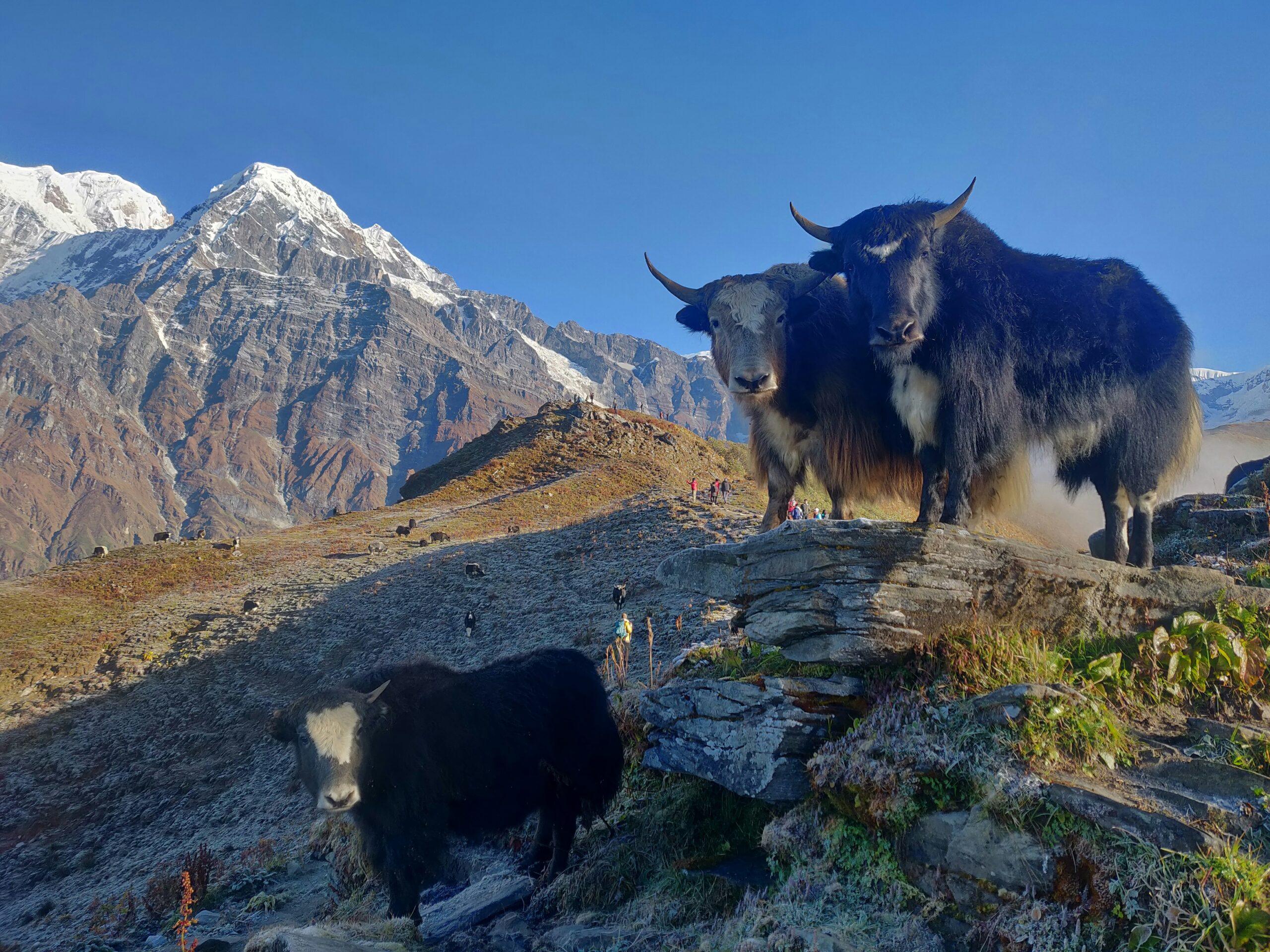
Yaks grazing along Mardi Himal Trek trail with snow peaks
Mardi Himal combines several experiences in one relatively short trek:
Pokhara → Forest → Rhododendron → Ridge → High Camp → Himalayan Panorama
Few short routes provide such a dramatic transition from subtropical landscapes to high-altitude mountain terrain within several days.
The biggest attraction is not simply the destination—it is the changing landscape throughout the journey.
Who Should Do the Mardi Himal Trek?
The trek is ideal for:
- First-time Himalayan trekkers
- Couples
- Solo travelers using a licensed guide
- Families with older teenagers and good fitness
- Photographers
- Nature lovers
- Adventure travelers
- Travelers with limited time
- Visitors staying in Pokhara
- Trekkers seeking Machhapuchhre views
It may be less suitable for people who are uncomfortable with steep trails, high altitude or basic mountain accommodation.
Why Book a Guided Mardi Himal Trek?
A professional trekking company can arrange:
- Licensed trekking guide
- TIMS card
- ACAP permit
- Accommodation
- Meals
- Transportation
- Porter services
- Route planning
- Emergency assistance
- Trekking equipment advice
A guide also helps with navigation, altitude management, weather decisions and communication with local teahouses.
Mardi Himal Trek Frequently Asked Questions
How long is the Mardi Himal Trek?
The standard Mardi Himal Trek generally takes 5–7 trekking days from Pokhara, although longer itineraries are available for slower-paced travelers.
How high is Mardi Himal Trek?
The upper viewpoint/Base Camp area is commonly cited at approximately 4,200–4,500 meters, depending on the itinerary.
Is Mardi Himal Trek difficult?
Mardi Himal is generally considered a moderate trek. It is suitable for fit beginners but includes steep sections and significant altitude gain.
Can beginners do the Mardi Himal Trek?
Yes. Fit beginners can complete the trek with proper preparation, a sensible itinerary and appropriate acclimatization.
What is the best month for Mardi Himal Trek?
The best periods are generally March–May and September–November. Nepal Tourism Board identifies these as the best trekking seasons for the Annapurna region.
Do I need a guide for Mardi Himal Trek?
Yes. Under the current Nepal Tourism Board provisions, Mardi Himal is specifically listed among Annapurna routes requiring a licensed trekking guide and agency-issued TIMS card.
What permits are required for Mardi Himal Trek?
Foreign trekkers generally need an Annapurna Conservation Area Permit and TIMS card. Current fees should be confirmed before departure.
Is Mardi Himal Trek suitable for families?
It can be suitable for families with older children or teenagers who are physically prepared for several hours of daily hiking and altitude.
Is there Wi-Fi on Mardi Himal Trek?
Some teahouses may offer Wi-Fi, particularly at lower elevations, but connectivity can be unreliable. Do not depend on internet access throughout the trek.
Is there electricity on the Mardi Himal Trek?
Electricity is available at many teahouses, but charging may cost extra and availability can vary at higher elevations. Carrying a power bank is recommended.
Can I trek Mardi Himal in winter?
Yes, but winter conditions can be cold and snow can affect the upper sections. Proper winter equipment and weather checks are essential.
Can I do Mardi Himal Trek during monsoon?
It is possible, but June–August generally brings heavy rainfall, clouds, slippery trails and reduced mountain visibility. Spring and autumn are preferable.
How much does Mardi Himal Trek cost?
A typical 2026 guided Mardi Himal Trek can cost approximately US$400–800+ per person, depending on group size, itinerary, inclusions and accommodation. Private and premium packages can cost more.
Final Thoughts
The Mardi Himal Trek is an excellent choice for travelers who want to experience the Himalayas without spending two or three weeks on the trail.
From the forests around Kande and Deurali to the spectacular ridge above High Camp, the landscape changes dramatically throughout the journey.
The combination of Machhapuchhre views, rhododendron forests, traditional villages, high-altitude ridges and a relatively short itinerary makes Mardi Himal one of Nepal’s most appealing short treks.
If you are looking for a Himalayan adventure that fits comfortably into a one-week itinerary, the Mardi Himal Trek is an outstanding choice.
Book Your Mardi Himal Trek
Ready to explore the Annapurna region?
Join us for an unforgettable Mardi Himal Trek in Nepal with experienced local guides, carefully planned itineraries, comfortable teahouse accommodation and reliable trekking support.
Contact us today to plan your Mardi Himal adventure.
For the latest information on trekking regulations, permits, conservation areas, and mountaineering requirements in Nepal, visit the official Nepal Tourism Board and relevant government authorities before planning your Pisang Peak Climbing adventure.
Also if you want to view our other treks then you can follow this link.


Reviews
There are no reviews yet.