

Everest Three Pass Trek-20 Days
$ 2,565.00$ 2,445.00
The Everest Three Passes Trek is an extraordinary adventure that takes trekkers far beyond the usual routes of the Everest region. Unlike the standard treks to Everest Base Camp or Gokyo, this journey pushes you through high-altitude terrain, remote valleys, and some of the most scenic passes in the world. Over a span of approximately 20 days, trekkers cross three of the highest passes in the Everest region—Kongma La (5,535 m), Cho La (5,420 m), and Renjo La (5,360 m). Each pass presents unique challenges, from icy slopes and steep ascents to unpredictable weather conditions, but the rewards are unmatched. The trek offers awe-inspiring views of the world’s tallest peaks, including Mount Everest (8,848 m), Lhotse (8,516 m), Cho Oyu (8,188 m), and Makalu (8,485 m), creating a visual experience that remains etched in the memory of every trekker. This trek is ideal for seasoned hikers who are comfortable with high-altitude trekking, as it demands stamina, endurance, and careful acclimatization. Along the way, trekkers experience the pristine natural beauty of the Khumbu region, pass through traditional Sherpa villages, and witness the rich Himalayan culture that is often missed on shorter, more conventional treks. The Everest Three Passes Trek truly combines physical challenge, cultural immersion, and breathtaking scenery in one unforgettable expedition.
Product Description
Everest Three Pass Trek: Cost, Itinerary, Difficulty & Complete Guide
The Everest Three Pass Trek is one of the most challenging and rewarding trekking adventures in Nepal. Also known as the Everest Three High Passes Trek, this spectacular circuit crosses three high mountain passes—Kongma La, Cho La, and Renjo La—while connecting some of the most famous destinations in the Everest region.
Unlike the standard Everest Base Camp Trek, the Everest Three Pass Trek takes you deep into the Khumbu’s high valleys and remote mountain landscapes. The route combines Everest Base Camp, Kala Patthar, Gokyo Lakes, Gokyo Ri, Chhukung, Thame, and three passes above 5,300 meters into one extraordinary Himalayan journey.
The three major crossings are Kongma La at approximately 5,535m, Cho La at approximately 5,420m, and Renjo La at approximately 5,360m. Kala Patthar, another major highlight, reaches approximately 5,545m.
With demanding high-altitude days, rocky terrain, glacial sections, and sustained exposure above 4,000 meters, the Everest Three Pass Trek is best suited to fit and experienced high-altitude trekkers.
If you are searching for the Everest Three Pass Trek itinerary, cost, difficulty, altitude, permits, best time, route, or packing list, this complete guide covers everything you need to know.
Everest Three Pass Trek Highlights
- Cross all three major Everest-region high passes
- Cross Kongma La – approximately 5,535m
- Cross Cho La – approximately 5,420m
- Cross Renjo La – approximately 5,360m
- Visit Everest Base Camp
- Hike to Kala Patthar
- Explore the spectacular Gokyo Lakes
- Climb Gokyo Ri
- Walk through the Khumbu and Gokyo valleys
- Experience the remote Thame Valley
- See Mount Everest, Lhotse, Nuptse, Makalu and Cho Oyu
- Walk alongside sections of the Khumbu and Ngozumpa glaciers
- Visit Namche Bazaar and Tengboche
- Experience Sherpa culture and Himalayan monasteries
- Enjoy a complete circuit of the Everest region
- Trek away from the busiest sections of the standard EBC route
What Is the Everest Three Pass Trek?
The Everest Three Pass Trek is a high-altitude circuit through Nepal’s Khumbu region.
The route links three major mountain passes:
- Kongma La – approximately 5,535m
- Cho La – approximately 5,420m
- Renjo La – approximately 5,360m
The circuit also incorporates several major Everest-region attractions, including Everest Base Camp, Kala Patthar, Gokyo Lakes and Gokyo Ri.
A typical route follows:
Lukla → Namche Bazaar → Tengboche → Dingboche → Chhukung → Kongma La → Lobuche → Everest Base Camp → Kala Patthar → Dzongla → Cho La → Thangnak → Gokyo → Renjo La → Thame → Namche → Lukla
Most organized itineraries take approximately 18–21 days from Lukla, although shorter and longer versions are available.
Everest Three Pass Trek Quick Facts
| Category | Details |
|---|---|
| Trek Name | Everest Three Pass Trek |
| Region | Khumbu / Everest Region |
| Country | Nepal |
| Typical Duration | 18–21 days |
| Difficulty | Very Challenging |
| Highest Trekking Point | Kala Patthar ~5,545m |
| Kongma La | ~5,535m |
| Cho La | ~5,420m |
| Renjo La | ~5,360m |
| Gokyo Ri | ~5,357m |
| Starting Point | Lukla |
| Ending Point | Lukla |
| Major Attractions | EBC, Gokyo Lakes, Kala Patthar |
| Accommodation | Teahouses / Lodges |
| Best Seasons | Spring and Autumn |
| Experience | Previous high-altitude trekking strongly recommended |
Exact elevations can vary slightly between published sources and route conditions.
Why Choose the Everest Three Pass Trek?
The Everest Three Pass Trek offers arguably the most complete trekking experience in the Khumbu.
Instead of following one route to Everest Base Camp and returning the same way, you travel through multiple valleys and high mountain passes.
1. Cross Three Himalayan High Passes
The three passes are the heart of the trek.
Kongma La
At approximately 5,535m, Kongma La is generally considered the most demanding of the three.
The route from Chhukung to Lobuche involves steep climbing, rocky terrain and potentially glacial or snow-covered sections depending on conditions.
Cho La
Cho La reaches approximately 5,420m.
The pass connects the Everest Base Camp region with the Gokyo Valley and includes a challenging high-altitude crossing with icy or glaciated terrain depending on the season.
Renjo La
Renjo La is approximately 5,360m and provides spectacular views toward Everest, Cho Oyu and the Gokyo Lakes.
Although often considered the easiest of the three, it remains a serious high-altitude crossing.
Everest Base Camp
The Everest Three Pass Trek includes the opportunity to visit Everest Base Camp, one of the world’s most famous trekking destinations.
At approximately 5,364m, Everest Base Camp sits at the foot of the Khumbu Icefall on the southern approach to Mount Everest.
Reaching Base Camp is a major highlight, but the Three Passes route continues far beyond it.
Kala Patthar
Kala Patthar is one of the best viewpoints in the Everest region.
At approximately 5,545m, the summit provides spectacular views of:
- Mount Everest
- Nuptse
- Pumori
- Lhotse
- Khumbu Glacier
- Surrounding Himalayan peaks
Many trekkers climb Kala Patthar early in the morning for sunrise.
Gokyo Lakes
The Gokyo Valley provides one of the most beautiful landscapes of the entire trek.
The turquoise Gokyo Lakes are surrounded by enormous Himalayan peaks and glacial landscapes.
The valley also provides access to Gokyo Ri, another spectacular viewpoint.
Gokyo Ri
At approximately 5,357m, Gokyo Ri offers an exceptional panorama of the Everest region.
From the summit, trekkers can see several major Himalayan peaks, including:
- Everest
- Lhotse
- Makalu
- Cho Oyu
- Cholatse
- Taboche
For many trekkers, the Gokyo Ri viewpoint rivals or even surpasses the views from Kala Patthar.
Everest Three Pass Trek Route
A classic route is:
Lukla → Phakding → Namche Bazaar → Tengboche → Dingboche → Chhukung → Kongma La → Lobuche → Gorak Shep → Everest Base Camp → Kala Patthar → Dzongla → Cho La → Thangnak → Gokyo → Gokyo Ri → Renjo La → Lungden → Thame → Namche Bazaar → Lukla
The exact sequence can vary.
The most commonly used direction gradually builds altitude before crossing the high passes and is designed to provide adequate acclimatization.
Everest Three Pass Trek Itinerary
Below is a representative 20-day Everest Three Pass Trek itinerary.
Actual itineraries may vary depending on acclimatization, weather, flight schedules and route conditions.
Day 1: Arrival in Kathmandu
Arrive in Kathmandu and transfer to your hotel.
Meet your trekking team and receive a briefing about the journey.
Altitude: Approximately 1,350m
Accommodation: Hotel
Day 2: Kathmandu Preparation and Sightseeing
Spend the day preparing for the trek.
Complete final equipment checks and explore Kathmandu if time permits.
Your trekking agency will finalize permits and logistics.
Accommodation: Hotel
Day 3: Fly to Lukla and Trek to Phakding
Take a flight toward Lukla, the traditional gateway to the Everest region.
From Lukla, begin trekking toward Phakding.
The trail passes through small villages and follows the Dudh Koshi Valley.
Lukla: ~2,860m
Phakding: ~2,610m
Trekking: Approximately 3–4 hours
Day 4: Phakding to Namche Bazaar
Continue north along the Dudh Koshi River.
Cross several suspension bridges and enter Sagarmatha National Park.
The final section climbs steeply toward Namche Bazaar.
Altitude: ~3,440m
Trekking: Approximately 5–7 hours
Day 5: Acclimatization at Namche Bazaar
Spend the day acclimatizing.
Optional hikes can include:
- Everest View Hotel
- Khumjung
- Khunde
- Sherpa villages
Namche is also an excellent place to prepare for the higher elevations ahead.
Day 6: Namche Bazaar to Tengboche
Continue through the beautiful Khumbu landscape.
The trail provides views of Everest, Ama Dablam, Lhotse and other Himalayan peaks.
Reach Tengboche, home to one of the region’s most important monasteries.
Altitude: ~3,860m
Trekking: Approximately 5–6 hours
Day 7: Tengboche to Dingboche
Descend toward the Imja Khola before climbing toward Pangboche and Dingboche.
The landscape becomes increasingly alpine as you gain altitude.
Altitude: ~4,410m
Trekking: Approximately 5–6 hours
Day 8: Acclimatization at Dingboche
Take an acclimatization day.
A popular option is hiking toward Nangkartshang Peak for views of:
- Ama Dablam
- Island Peak
- Makalu
- Lhotse
- surrounding valleys
Return to Dingboche for the night.
Day 9: Dingboche to Chhukung
Continue toward Chhukung, a small settlement in the Imja Valley.
This short day helps with acclimatization before the demanding Kongma La crossing.
Altitude: ~4,730m
Trekking: Approximately 3–4 hours
Day 10: Chhukung to Lobuche via Kongma La
This is one of the hardest days of the trek.
Start early and climb toward Kongma La at approximately 5,535m.
The route involves steep and rocky terrain and can be snow-covered depending on conditions.
After crossing the pass, descend toward the Khumbu Glacier and eventually reach Lobuche.
Highest altitude: ~5,535m
Trekking: Approximately 8–10 hours
Day 11: Lobuche to Everest Base Camp and Gorak Shep
Continue along the Khumbu Glacier toward Gorak Shep.
After reaching Gorak Shep, continue toward Everest Base Camp.
Explore the Base Camp area before returning to Gorak Shep.
Everest Base Camp: ~5,364m
Trekking: Approximately 7–9 hours
Day 12: Gorak Shep to Kala Patthar and Dzongla
Wake early and hike toward Kala Patthar.
At approximately 5,545m, the viewpoint provides spectacular sunrise views of Everest and the surrounding peaks.
Return toward Gorak Shep for breakfast before continuing toward Dzongla.
Highest altitude: ~5,545m
Trekking: Approximately 7–9 hours
Day 13: Dzongla to Thangnak via Cho La
Begin early for the Cho La Pass crossing.
The ascent becomes increasingly steep and rocky before reaching the pass at approximately 5,420m.
Snow and ice conditions can make this section particularly demanding.
Descend toward Thangnak.
Highest altitude: ~5,420m
Trekking: Approximately 7–9 hours
Day 14: Thangnak to Gokyo
Continue toward the beautiful Gokyo Valley.
Cross the Ngozumpa Glacier and reach Gokyo.
The turquoise lakes and surrounding peaks create one of the trek’s most spectacular landscapes.
Altitude: ~4,790m
Trekking: Approximately 4–6 hours
Day 15: Gokyo Ri and Gokyo Lakes
Wake early and climb Gokyo Ri.
At approximately 5,357m, the summit offers panoramic views of Everest, Lhotse, Makalu and Cho Oyu.
Return to Gokyo and explore the lakes.
Highest altitude: ~5,357m
Trekking: Approximately 4–5 hours
Day 16: Gokyo to Thame via Renjo La
Another major pass-crossing day.
Climb toward Renjo La at approximately 5,360m.
From the summit, enjoy spectacular views of the Everest massif and Gokyo Lakes.
Descend toward the Bhote Koshi Valley and continue toward Lungden or Thame depending on the itinerary.
Highest altitude: ~5,360m
Trekking: Approximately 7–8 hours
Day 17: Thame to Namche Bazaar
Descend through the historic Thame Valley.
The area has strong connections with traditional Sherpa culture and famous mountaineers.
Continue toward Namche Bazaar.
Altitude: ~3,440m
Trekking: Approximately 5–7 hours
Day 18: Namche Bazaar to Lukla
Follow the Dudh Koshi Valley back toward Lukla.
This is the final trekking day.
Celebrate the completion of the Three Passes circuit with your trekking team.
Trekking: Approximately 6–8 hours
Day 19: Fly Lukla to Kathmandu
Take the morning flight back to Kathmandu, weather permitting.
The rest of the day is free for relaxation or exploring Kathmandu.
Day 20: Departure
Transfer to the airport for your international flight.
Your Everest Three Pass Trek adventure comes to an end.
Everest Three Pass Trek Difficulty
The Everest Three Pass Trek is very challenging.
It is widely regarded as one of the most demanding standard teahouse treks in the Everest region.
The main challenges include:
- Three passes above 5,300m
- Long trekking days
- High altitude
- Rocky and uneven terrain
- Glacial sections
- Snow and ice depending on conditions
- Significant elevation gain and loss
- Cold temperatures
- Limited oxygen
- Multiple consecutive high-altitude days
The challenge is not simply reaching one high point. The route requires trekkers to cross three separate high passes while remaining at high altitude for an extended period.
Is Everest Three Pass Trek Suitable for Beginners?
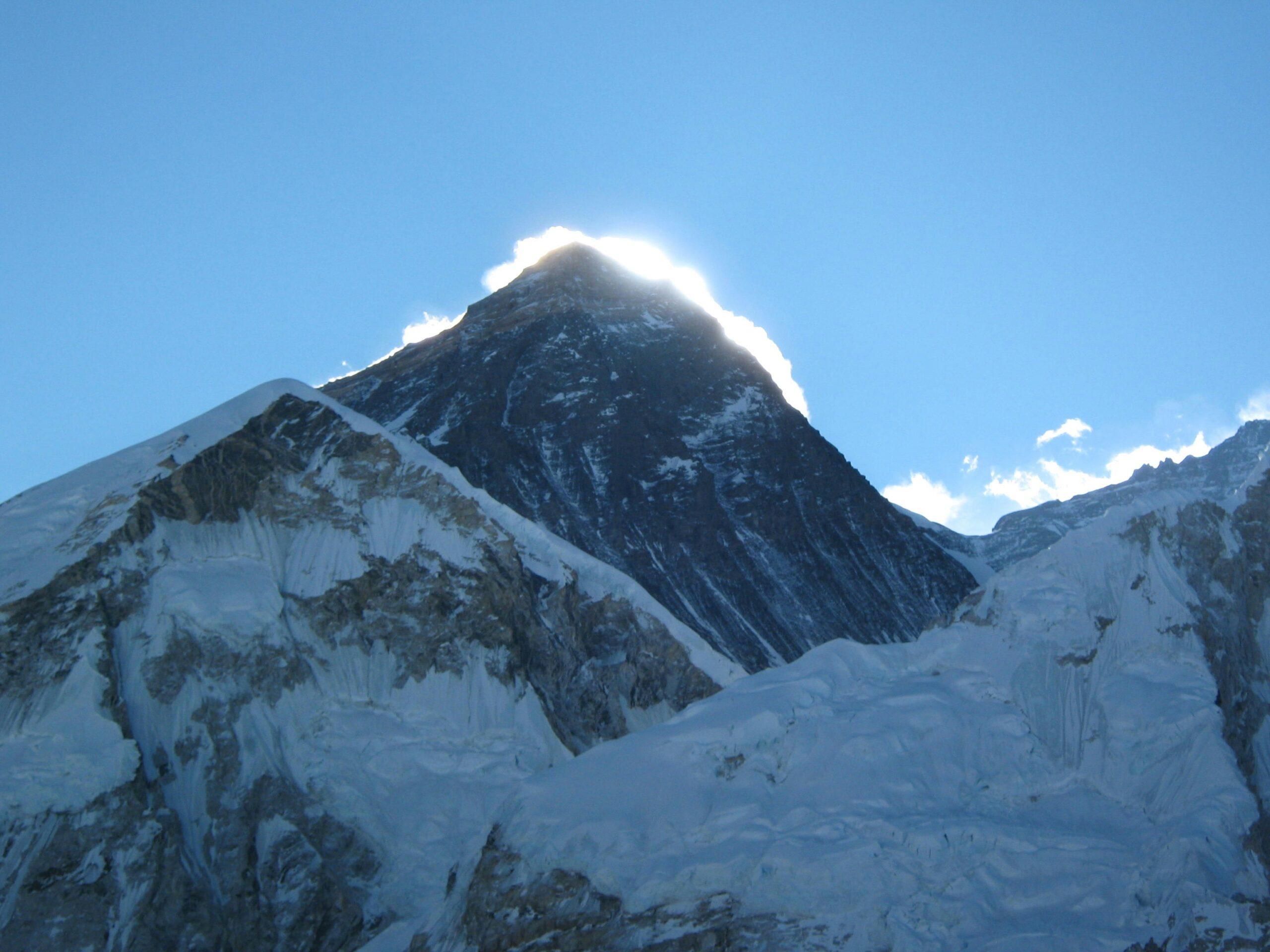
Mount Everest summit illuminated by sunlight during the Three Pass Trek
Generally, no.
The trek is best suited to people with previous high-altitude trekking experience.
Ideally, trekkers should already be comfortable hiking above 4,000–4,500 meters.
Previous experience on routes such as:
- Everest Base Camp
- Annapurna Circuit
- Manaslu Circuit
- Langtang Valley
- Dhaulagiri Circuit
can be valuable.
Current 2026 trekking guidance specifically recommends previous experience above roughly 4,500m for the Three Passes route.
Everest Three Pass Trek Altitude
Altitude is one of the biggest challenges of the trek.
| Location | Approx. Altitude |
|---|---|
| Kathmandu | 1,350m |
| Lukla | 2,860m |
| Namche Bazaar | 3,440m |
| Tengboche | 3,860m |
| Dingboche | 4,410m |
| Chhukung | 4,730m |
| Kongma La | 5,535m |
| Lobuche | 4,940m |
| Everest Base Camp | 5,364m |
| Kala Patthar | ~5,545m |
| Dzongla | ~4,830m |
| Cho La | ~5,420m |
| Thangnak | ~4,700m |
| Gokyo | ~4,790m |
| Gokyo Ri | ~5,357m |
| Renjo La | ~5,360m |
| Thame | ~3,820m |
| Namche | ~3,440m |
Published elevations vary slightly between sources, particularly for some settlements and viewpoints.
Altitude Sickness on the Everest Three Pass Trek
Altitude sickness is a serious concern.
Possible symptoms include:
- Headache
- Nausea
- Dizziness
- Fatigue
- Loss of appetite
- Difficulty sleeping
- Shortness of breath
The best prevention strategy is proper acclimatization and gradual ascent.
Trekkers should:
- Walk slowly
- Stay hydrated
- Eat properly
- Avoid excessive alcohol
- Follow acclimatization days
- Listen to their guide
- Never ignore worsening symptoms
- Descend if serious altitude-related symptoms develop
Everest Three Pass Trek Best Time
The best seasons for the Everest Three Pass Trek are generally spring and autumn.
The most popular periods are:
Spring: March to May
Spring offers:
- Improving weather
- Good visibility
- Warmer temperatures
- Rhododendron blooms
- Favorable trekking conditions
April and May are particularly popular.
Autumn: September to November
Autumn is widely considered the best overall trekking season.
You can expect:
- Clear mountain views
- Stable weather
- Good visibility
- Cool temperatures
- Better high-pass conditions
October and November are especially popular for high-altitude trekking. Current 2026 guides identify October–November and April–May as prime periods.
Winter
Winter brings extreme cold and snow.
The passes can become significantly more difficult or temporarily impassable.
Monsoon
June to August brings monsoon conditions to much of Nepal.
Rain and cloud can affect lower elevations, while snow and route conditions remain concerns at the high passes.
Everest Three Pass Trek Cost
The Everest Three Pass Trek cost varies according to group size, guide services, accommodation, transportation, flights, meals and package inclusions.
Current 2026 commercial packages range roughly from US$1,650 to US$5,500+ per person, with many guided packages falling around US$1,800–3,200 depending on the service level.
A typical package may include:
- Kathmandu accommodation
- Lukla flights
- Trekking guide
- Porter
- Teahouse accommodation
- Trekking permits
- National park fees
- Breakfast/lunch/dinner
- Airport transfers
- Ground transportation
- Staff insurance
- Guide and porter wages
Costs can increase with:
- Private guides
- Luxury lodges
- Larger porter-to-trekker ratios
- Extra acclimatization days
- Helicopter transportation
- Additional hotel nights
- Personal equipment
Always check exactly what is included before booking.
Everest Three Pass Trek Permits
The Everest Three Pass Trek passes through Sagarmatha National Park.
The Nepal Tourism Board currently lists the foreign visitor entry fee for Sagarmatha National Park at NPR 3,000 per person.
Current 2026 trekking sources also report a Khumbu Pasang Lhamu Rural Municipality fee of NPR 3,000, while TIMS requirements can differ from other trekking regions.
Because trekking regulations and fees can change, your trekking agency should confirm the latest requirements before departure.
Everest Three Pass Trek Accommodation
Unlike remote camping routes such as Upper Dolpo or Dhaulagiri, the Everest Three Pass Trek is primarily a teahouse trek.
Most nights are spent in local lodges.
Typical teahouse facilities include:
- Private or shared rooms
- Beds and mattresses
- Blankets
- Dining rooms
- Hot meals
- Tea and coffee
- Hot showers in some villages
- Wi-Fi in some locations
- Charging facilities in many lodges
Facilities become increasingly basic at higher elevations.
Food on the Everest Three Pass Trek
Teahouses offer a surprisingly wide variety of food.
Common meals include:
Breakfast
- Porridge
- Eggs
- Pancakes
- Tibetan bread
- Toast
- Muesli
- Tea
- Coffee
Lunch
- Dal bhat
- Noodles
- Pasta
- Fried rice
- Momos
- Soup
Dinner
- Dal bhat
- Pasta
- Pizza
- Noodles
- Sherpa stew
- Potatoes
- Vegetables
- Soup
Dal bhat remains one of the best choices because it provides carbohydrates, protein and substantial energy for long trekking days.
Everest Three Pass Trek Packing List
Proper equipment is essential.
Clothing
- Thermal base layers
- Fleece jacket
- Down jacket
- Waterproof jacket
- Waterproof trousers
- Trekking trousers
- Warm socks
- Gloves
- Warm hat
- Sun hat
- Buff
Footwear
- Waterproof trekking boots
- Camp shoes
- Warm socks
- Gaiters
High-Altitude Equipment
Depending on conditions and your guide’s recommendation:
- Trekking poles
- Crampons or microspikes
- Ice axe where required
- Headlamp
- Sunglasses
- Goggles for severe conditions
Current trekking sources note that snow and ice conditions can make additional equipment necessary, particularly around Cho La and Kongma La.
Sleeping Equipment
- Four-season sleeping bag
- Sleeping bag liner
- Warm nightwear
Personal Equipment
- Backpack
- Duffel bag
- Water bottles
- Water purification tablets/filter
- Sunscreen
- Lip balm
- Personal medication
- First-aid kit
- Power bank
- Camera
- Waterproof bags
Physical Preparation for Everest Three Pass Trek
Begin training several months before the trek.
Cardiovascular Training
Include:
- Hiking
- Running
- Cycling
- Stair climbing
- Brisk walking
Strength Training
Focus on:
- Squats
- Lunges
- Step-ups
- Calf raises
- Core exercises
Hiking Training
Long hikes with a backpack are particularly useful.
Gradually increase:
- Distance
- Elevation gain
- Backpack weight
- Consecutive hiking days
The goal is to build endurance rather than simply maximum strength.
Everest Three Pass Trek Safety Tips
1. Use an Experienced Guide
The three passes can become dangerous in poor weather or snow conditions.
2. Never Rush Acclimatization
Your body needs time to adapt to altitude.
3. Start Early on Pass Days
Weather is often more favorable earlier in the day.
4. Check Conditions Before Crossing
Snow and ice can change the difficulty of a pass dramatically.
5. Carry Proper Equipment
Your guide should assess whether crampons, microspikes or other equipment are required.
6. Stay Hydrated
Dehydration can make altitude symptoms worse.
7. Have Travel Insurance
Insurance should cover high-altitude trekking and emergency evacuation.
8. Build Buffer Days Into Your Itinerary
Mountain weather can delay Lukla flights.
Current trekking guides specifically recommend allowing extra time because flights can be affected by weather.
Everest Three Pass Trek vs Everest Base Camp Trek
| Feature | Three Pass Trek | Everest Base Camp |
|---|---|---|
| Difficulty | Very challenging | Moderate to challenging |
| Duration | 18–21 days | Usually 12–16 days |
| High Passes | 3 | None |
| Highest Point | ~5,545m | ~5,545m at Kala Patthar |
| Everest Base Camp | Yes | Yes |
| Gokyo Lakes | Yes | No |
| Gokyo Ri | Yes | Usually no |
| Remoteness | High | Moderate |
| Experience | Experienced trekkers | Wider range |
| Terrain | More demanding | More established |
If your primary goal is simply reaching Everest Base Camp, the standard EBC Trek is more accessible.
If you want to experience the complete Khumbu, the Three Pass Trek is the superior choice.
Everest Three Pass Trek vs Manaslu Circuit Trek
| Feature | Three Pass Trek | Manaslu Circuit |
|---|---|---|
| Region | Everest / Khumbu | Manaslu |
| Difficulty | Very challenging | Challenging |
| Highest Point | ~5,545m | ~5,106m |
| High Passes | 3 | 1 major pass |
| Accommodation | Teahouse | Teahouse |
| Everest Views | Exceptional | No Everest |
| Restricted Area | No | Yes |
| Crowds | Moderate on EBC sections | Lower |
| Technical Terrain | Some glacial sections | Less |
| Duration | 18–21 days | Usually 14–20 days |
The Three Passes Trek is better for trekkers wanting multiple high passes and classic Everest-region scenery.
Who Should Do the Everest Three Pass Trek?
The trek is ideal for:
- Experienced Himalayan trekkers
- Fit adventure travelers
- Everest enthusiasts
- Experienced EBC trekkers
- Mountain photographers
- High-altitude trekking enthusiasts
- Travelers seeking a complete Khumbu experience
It is not ideal for:
- First-time high-altitude trekkers
- People uncomfortable with long trekking days
- Travelers with limited physical preparation
- People looking for an easy Everest holiday
- Travelers who prefer luxury accommodation throughout
Why Book a Guided Everest Three Pass Trek?
A professional guide provides valuable support during the most difficult sections.
A guided trek can help with:
- Route navigation
- Accommodation
- Permits
- Weather decisions
- High-pass crossings
- Altitude monitoring
- Emergency coordination
- Equipment recommendations
- Local cultural interpretation
For the Three Passes route, experienced local guidance is particularly valuable because weather and trail conditions around the high passes can change rapidly.
Frequently Asked Questions About Everest Three Pass Trek
How difficult is the Everest Three Pass Trek?
The Everest Three Pass Trek is considered very challenging. It involves three passes above 5,300m, long trekking days, high-altitude exposure and potentially snowy or glaciated terrain.
How long is the Everest Three Pass Trek?
Most complete itineraries take approximately 18–21 days from Lukla, although some operators offer shorter or longer versions.
What are the three passes in Everest Three Pass Trek?
The three passes are:
- Kongma La – ~5,535m
- Cho La – ~5,420m
- Renjo La – ~5,360m
What is the highest point of the Everest Three Pass Trek?
Kala Patthar, at approximately 5,545m, is slightly higher than Kongma La on the standard route.
Is Everest Three Pass Trek harder than Everest Base Camp?
Yes. It is substantially more demanding because you cross three high passes and spend more time at extreme altitude.
Is Everest Three Pass Trek suitable for beginners?
No. Previous high-altitude trekking experience is strongly recommended.
What is the best time for Everest Three Pass Trek?
The best seasons are generally spring and autumn, particularly April–May and October–November.
How much does Everest Three Pass Trek cost?
Current 2026 guided packages range broadly from around US$1,650 to US$5,500+, depending on service level and inclusions, with many standard guided packages around US$1,800–3,200.
Do I need a guide for the Everest Three Pass Trek?
An experienced guide is strongly recommended, particularly for the high-pass and glacial sections.
Can I do Everest Base Camp and Three Passes together?
Yes. The standard Three Passes route incorporates Everest Base Camp and Kala Patthar into the circuit.
Which of the three passes is hardest?
Kongma La is commonly regarded as the most physically demanding, although difficulty varies according to weather, snow, route conditions and individual fitness.
Book Your Everest Three Pass Trek in Nepal
The Everest Three Pass Trek is the ultimate adventure for trekkers who want to experience more than the classic Everest Base Camp route.
From the bustling streets of Namche Bazaar to the quiet trails of the Gokyo and Thame valleys, from Kongma La and Cho La to Renjo La, and from Everest Base Camp and Kala Patthar to the turquoise Gokyo Lakes, this trek showcases the extraordinary diversity of the Khumbu.
It is demanding, but that is precisely what makes it special.
If you are physically prepared, have previous high-altitude trekking experience and want to experience the Everest region at its fullest, the Everest Three Pass Trek should be at the top of your Himalayan trekking list.
Contact us today to plan your Everest Three Pass Trek in Nepal and begin your journey across the legendary high passes of the Khumbu.
For the latest information on trekking regulations, permits, conservation areas, and mountaineering requirements in Nepal, visit the official Nepal Tourism Board and relevant government authorities before planning your Pisang Peak Climbing adventure.
Also if you want to view our other treks then you can follow this link.

Reviews
There are no reviews yet.