
Best Time for Trekking in Nepal: Month by Month Guide
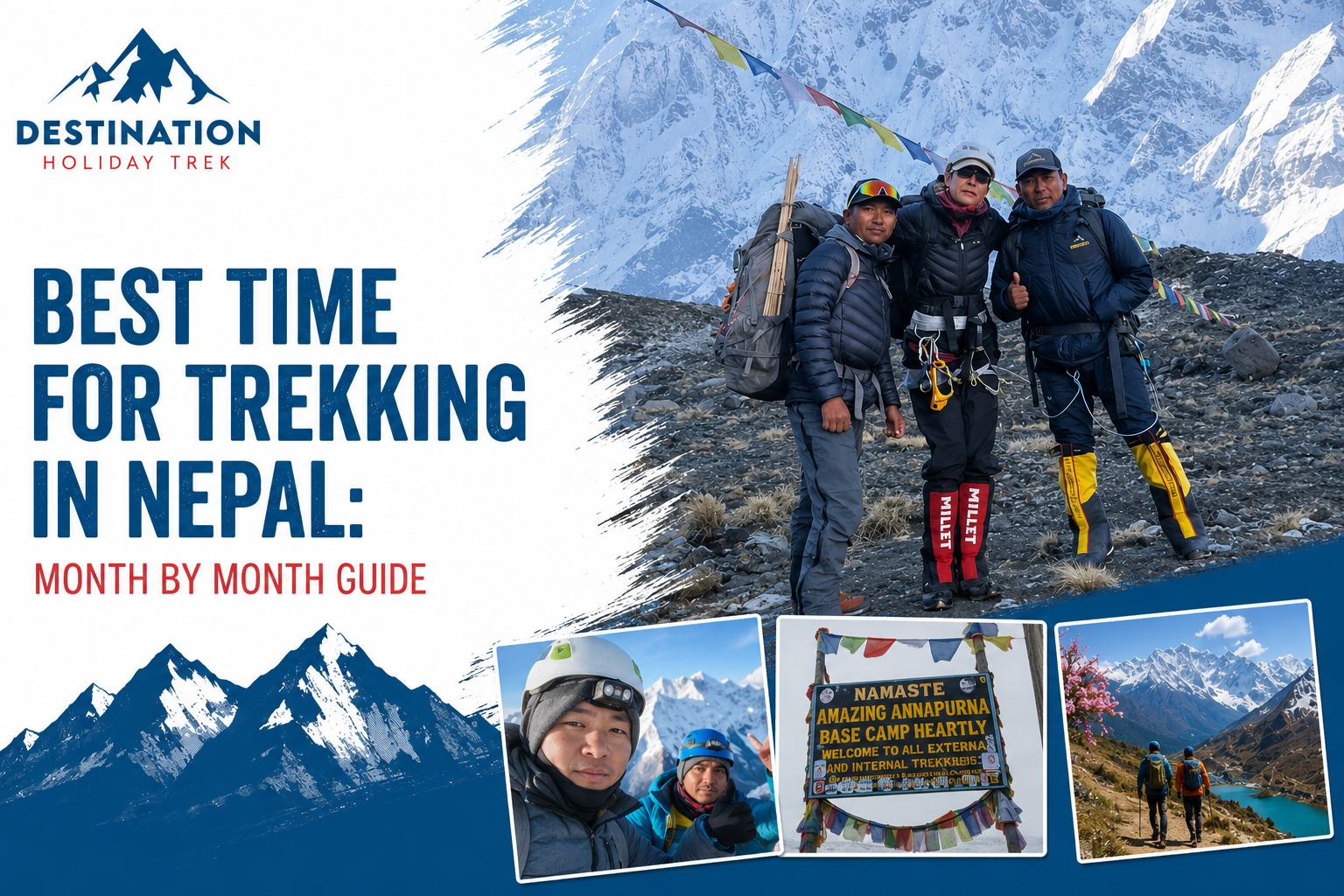
Table of Content
Introduction
Choosing the best time for trekking in Nepal depends on more than just picking spring or autumn. Weather, trail conditions, crowd levels, and even the specific region you plan to visit all play a part in how enjoyable your trek will be. This guide from Destination Holiday Trek walks through each month of the year so you can match your trip to the conditions that matter most to you.
Nepal recorded 1,158,459 international tourist arrivals in 2025, according to the Nepal Tourism Board, a slight rise from 1,147,548 in 2024 and just short of the 2019 record of 1,197,191. October 2025 was the busiest month with 128,443 arrivals, reflecting the peak autumn trekking season, while Jan to Jul 2026 arrivals reached 692,887, already ahead of the same period in 2025. These figures cover all visitor purposes, and trekking and mountaineering together make up a meaningful share, so understanding how seasons affect trails and crowds matters before committing to a departure date.
What Is the Best Time for Trekking in Nepal?
Spring and autumn are generally the most favorable seasons for trekking in Nepal, but the ideal month still depends on your chosen region, altitude, tolerance for crowds, and weather preferences.
- Spring: March to May
- Autumn: September to November
- Winter: December to February
- Monsoon: June to August
These four seasons behave differently by region. Rain shadow areas such as Upper Mustang, along with parts of Annapurna and Manaslu, sit behind the main Himalayan range and receive far less rainfall during monsoon. A trek that would be unpleasant in the Everest region during July can still work well in Mustang the same month. No single season fits every trek in Nepal equally.
Month by Month Trekking Guide
Temperatures in Nepal vary enormously by altitude and region, so instead of listing exact figures for every location, the table below focuses on general conditions, visibility, crowds, and suitable regions for each month.
| Month | Season | Trail Conditions | Visibility | Crowd Level | Recommended Regions |
| January | Winter | Cold, dry, snow at high altitude | Often clear | Low | Lower Annapurna, Langtang |
| February | Winter | Cold, improving | Often clear | Low to moderate | Everest lower routes, Annapurna |
| March | Spring | Warming, some rain at low elevation | Good, improving | Moderate | Everest, Annapurna, Langtang |
| April | Spring | Warm, stable | Very good | High | Everest, Annapurna, Manaslu |
| May | Spring | Warm, some pre monsoon haze | Good, hazier by late May | High | Everest, Annapurna, high passes |
| June | Monsoon | Wet, muddy at low elevation | Reduced | Low | Upper Mustang |
| July | Monsoon | Heavy rain, slippery trails | Poor at low elevation | Very low | Upper Mustang, rain shadow Manaslu |
| August | Monsoon | Wet, landslide risk in hills | Poor at low elevation | Very low | Upper Mustang |
| September | Autumn transition | Drying trails, some late rain | Improving | Moderate | Everest, Annapurna, Langtang |
| October | Autumn | Stable, dry | Excellent | Very high | Everest, Annapurna, Manaslu |
| November | Autumn | Stable, cold nights | Excellent | High | Everest, Annapurna, high passes |
| December | Winter | Cold, some snow at altitude | Often clear | Low | Lower Annapurna, Langtang |
Spring Trekking in Nepal: March to May
Spring is one of the two peak trekking seasons, bringing a gradual warming trend across the country. Lower and mid elevation trails become greener as the season progresses, and rhododendron forests bloom across much of the hill country, particularly through March and April.
Mountain visibility is generally good in the mornings, though afternoon cloud buildup is common, and haze can increase toward late May before the monsoon. Trail conditions are typically dry and stable at lower elevations, while higher passes may still hold snow early in the season.
Spring suits a wide range of treks, including the Everest Base Camp Trek, the Annapurna Base Camp Trek, the Annapurna Circuit Trek, and the Langtang Trek, and it is also strong for high altitude routes such as the Manaslu Circuit Trek once winter snow has cleared from the passes.
The main drawback is popularity. April sees heavy foot traffic on major routes, and teahouses along the busiest trails can fill quickly. Trekkers who prefer quieter trails may find March or early May more comfortable than the height of April.
Autumn Trekking in Nepal: September to November
Autumn follows the summer monsoon and is widely regarded as the most reliable season for trekking in Nepal. Once the rains clear, usually by mid to late September, the atmosphere is washed clean of dust, producing some of the clearest mountain views of the year.
Weather tends to stay stable for extended stretches, with dry trails and moderate daytime temperatures at most trekking elevations. Nights grow progressively colder toward November, especially above 4000 meters. This is also when Nepal’s major festivals, including Dashain and Tihar, often fall, adding a cultural dimension to treks passing through Hindu and Buddhist communities.
October draws the highest number of trekkers of any month, combining dry trails, clear skies, and comfortable temperatures. November offers similar conditions with somewhat smaller crowds, particularly in the final weeks, though nights at altitude turn noticeably colder. Both months suit the Everest Base Camp Trek, the Everest Three Pass Trek, and the Annapurna Circuit Trek, where clear conditions matter most for crossing high passes safely.
The tradeoff is the same as in spring: popularity. Flights to mountain airstrips can be fully booked well in advance during peak weeks, so planning permits and accommodation early is worthwhile.
Winter Trekking in Nepal: December to February
Winter does not mean trekking comes to a halt, but it does mean adjusting expectations. Daytime temperatures at lower and mid elevations can still be pleasant on clear, sunny days, while nights and higher altitudes turn genuinely cold.
Snow becomes a real factor above roughly 4000 meters, and some high passes may be difficult or temporarily closed after heavy snowfall. Teahouses at higher elevations often reduce services or close during the quietest weeks, so itinerary planning matters more than in peak season.
The clear advantage is solitude. Trails crowded in October can feel almost empty in January, with remarkably clear skies on dry winter days. Lower altitude treks in the Annapurna foothills and parts of Langtang stay accessible throughout winter, while high routes require proper cold weather gear and flexible scheduling.
Monsoon Trekking in Nepal: June to August
Monsoon is the least popular season for trekking in most of Nepal, and for good reason. Rainfall is frequent and heavy, trails at lower elevations become muddy and slippery, and leeches are common in forested sections. Landslide risk increases in the hills, and flights to mountain airstrips face a higher chance of delay due to poor visibility.
There is an important exception. Regions sitting in the rain shadow of the main Himalayan range receive significantly less rainfall, because the mountains block most of the monsoon clouds before they arrive. Upper Mustang is the clearest example, and parts of Manaslu and Annapurna north of the main peaks can also stay comparatively dry, making them a practical alternative to the wetter routes further south.
Best Time by Popular Trekking Region
The best month is not identical across every part of Nepal, since altitude, rainfall patterns, and terrain vary considerably between regions.
- Everest Region: Spring and autumn offer the most reliable weather for routes like the Everest Base Camp Trek and the Everest Three Pass Trek. Winter suits experienced trekkers seeking solitude, while monsoon is generally discouraged due to cloud cover and flight disruption to Lukla.
- Annapurna Region: Both spring and autumn suit the Annapurna Base Camp Trek well, while the longer Annapurna Circuit Trek is best attempted outside the heaviest winter snow at Thorong La pass.
- Langtang Region: Closer to Kathmandu and somewhat lower in elevation, the Langtang Trek offers a slightly wider window, including parts of late winter and early spring.
- Manaslu Region: Spring and autumn are strongest for the Manaslu Circuit Trek, since the Larkya La pass can become hazardous during heavy snow or monsoon rain.
- Upper Mustang: This rain shadow region is one of the few in Nepal genuinely well suited to monsoon trekking, in addition to spring and autumn.
For a full overview of routes across these regions, Destination Holiday Trek’s Nepal trekking packages cover options for every season and experience level.
Best Time for Popular Treks in Nepal
- Everest Base Camp Trek: Spring and autumn, for clear passes and reliable Lukla flights.
- Everest Three Pass Trek: Spring and autumn, since crossing three high passes safely depends on stable weather.
- Annapurna Circuit Trek: Spring and autumn, avoiding heavy snow at Thorong La.
- Annapurna Base Camp Trek: Spring and autumn, with winter possible at lower sections.
- Langtang Trek: Spring and autumn, with some flexibility into late winter.
- Manaslu Circuit Trek: Spring and autumn, when the Larkya La pass is most reliably passable.
Trekkers considering peak climbs alongside a standard trek should note that routes such as the Ama Dablam Expedition, Island Peak Climbing, Mera Peak Expedition, Lobuche East Peak Climbing, and Chulu Far East Climbing generally follow the same spring and autumn windows, since climbing depends on the same stable weather.
How to Choose the Best Month for Your Trek
- Best for clear mountain views: October and early November, when post monsoon air is cleanest.
- Best for fewer crowds: January, February, or June, when trail traffic drops.
- Best for rhododendron flowers: March and April, at peak bloom in the mid hills.
- Best for warmest conditions: April and May, particularly at lower and mid elevations.
- Best for winter solitude: December through February, on lower altitude routes with proper cold weather gear.
- Best for rain shadow trekking: June through August in Upper Mustang and similar dry belt regions.
- Best for first time trekkers: October or April, combining stable weather with well supported infrastructure.
Weather and Altitude Considerations
Weather in Nepal changes according to altitude, region, season, local geography, and time of day. A morning that starts clear at 3000 meters can turn cloudy by early afternoon as warm air rises and moisture builds around the peaks, which is why trekking days often begin early to catch the clearest views.
Conditions at 5000 meters can differ dramatically from the valley below on the same day, and Himalayan weather can change quickly regardless of season. Forecasts and seasonal averages should be treated as guidance rather than guarantees.
Trekking Permits and Official Information
Permit requirements in Nepal vary by region and route, and some areas require more than one type of permit. Before finalizing travel dates, review the official trekking permit guidance from the Nepal Tourism Board. Conservation area permits for regions managed by the National Trust for Nature Conservation, including parts of Annapurna and Manaslu, can be arranged through the official online permit system. Confirming permit rules alongside your chosen season helps avoid last minute complications on the trail.
For further planning resources across seasons and regions, Destination Holiday Trek’s Nepal trekking guides cover additional route specific advice.
Conclusion
Nepal does not have a single best month for trekking. Spring brings blooming rhododendrons and warm, stable trails, autumn delivers the clearest skies and busiest but most reliable conditions, winter rewards prepared trekkers with quiet trails and crisp views, and even the monsoon has a place for those heading into rain shadow regions like Upper Mustang. The right choice ultimately comes down to your chosen route, your altitude tolerance, your crowd preference, and how much flexibility you have around flights and weather. Once you have a season in mind, explore Destination Holiday Trek’s Nepal trekking packages or get in touch directly to plan a route and timeframe that fits your goals.
Frequently Asked Questions
- What is the best month for trekking in Nepal?
October is generally considered the strongest single month, thanks to stable post monsoon weather and clear mountain visibility, though April is a close second for many trekkers. - Which season is best for trekking in Nepal?
Autumn, from September to November, and spring, from March to May, are the two most reliable seasons overall, though the better choice depends on your specific route and priorities. - Can you trek in Nepal during the monsoon?
Yes, particularly in rain shadow regions such as Upper Mustang, though most other regions experience wet trails, reduced visibility, and a higher risk of flight delays during these months. - Can you trek in Nepal during winter?
Yes. Lower and mid elevation treks remain accessible with proper cold weather gear, while high altitude passes require more caution due to snow and cold temperatures. - Is October the best month for trekking in Nepal?
October is often cited as the single best month because of its clear skies and stable weather, but it is also the busiest, so trekkers who prefer quieter trails may prefer April, early September, or late November instead. - What is the best time for the Everest Base Camp Trek?
Spring and autumn offer the most reliable weather and flight conditions for reaching Lukla and completing the trek to Base Camp. - Which Nepal treks are suitable during monsoon?
Treks in Upper Mustang and parts of the Manaslu and Annapurna regions that lie in the rain shadow of the Himalayas remain reasonably dry and trekkable during the monsoon months.