
Best Mountain Expeditions in Nepal for Adventure Seekers
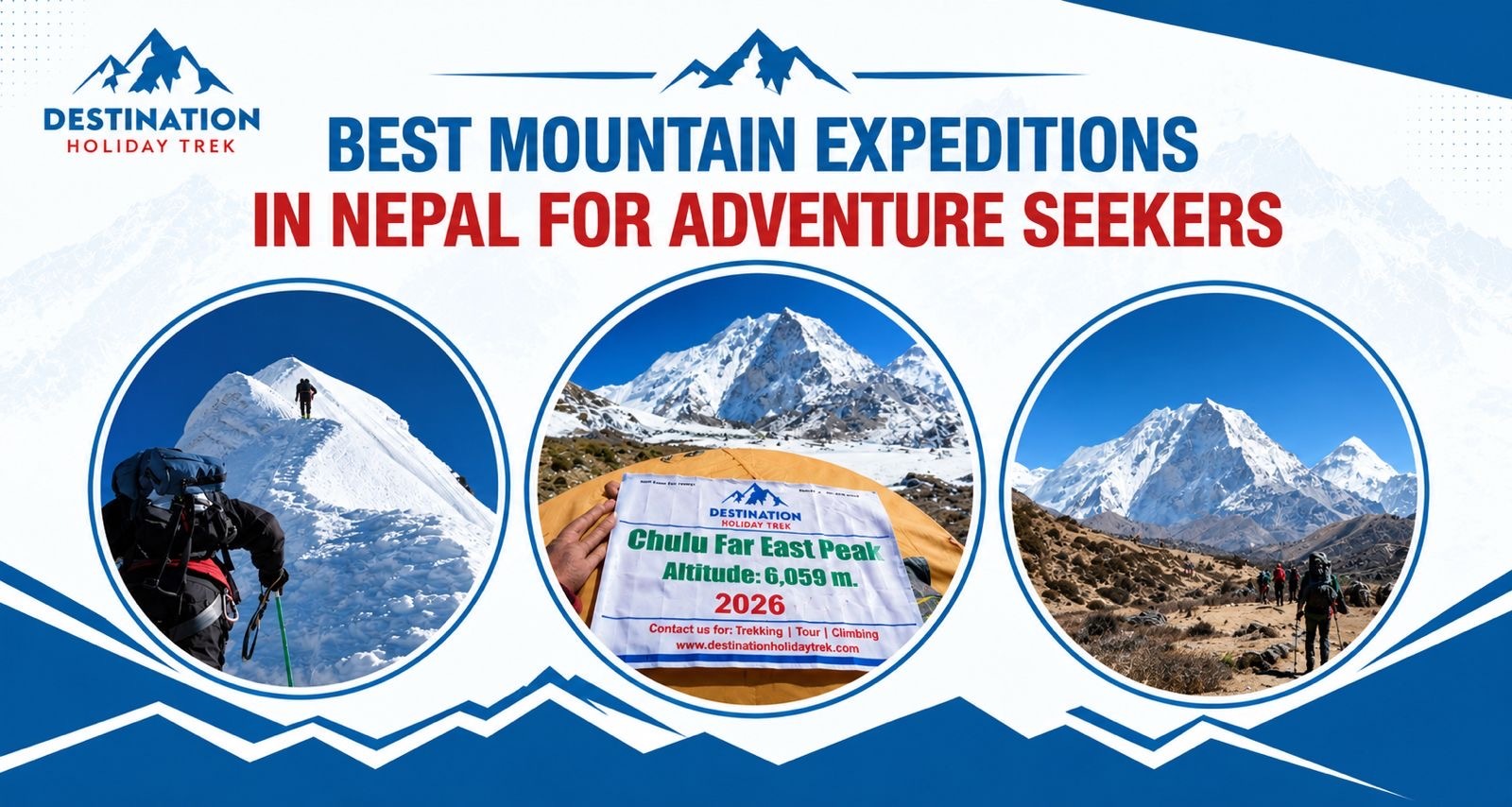
Table of Content
Introduction
Best mountain expeditions in Nepal for adventure seekers range from 6,000 metre trekking peaks to 8,000 metre giants, because Nepal is home to eight of the world’s 14 peaks above 8,000 metres and to dozens of 6,000 metre summits that a fit trekker can reach with the right guide and training. That range is why the best mountain expeditions in Nepal suit almost every level, from a first Himalayan climb to a serious 8,000 metre attempt.
This guide compares 10 of them: Pisang Peak, Island Peak, Lobuche East, Mera Peak, Chulu Far East, Himlung Himal, Baruntse, Pumori, Dhaulagiri and Manaslu. For each one you will find the height, region, difficulty, best season and the kind of climber it suits, so you can choose a peak that matches your experience, fitness and schedule.
Destination Holiday Trek & Expedition Pvt. Ltd. is a Sherpa family-run company based in Kathmandu, established in 2017 and registered in Nepal (Company Reg. No. 179974/074/075). We are a member of the Trekking Agencies’ Association of Nepal (TAAN), the Nepal Mountaineering Association (NMA) and the Nepal Tourism Board (NTB), and government-licensed guides lead our climbs. You can meet our team, read our legal documents or learn about the company before you book.
Why Choose Nepal for Mountain Expeditions?
Nepal combines high peaks, well-established climbing logistics and a deep mountaineering culture. Five reasons climbers keep coming back:
- A peak for every level. Trekking peaks around 6,000 metres suit first-time climbers, 7,000 metre peaks build expedition skills, and 8,000 metre giants test experienced mountaineers.
- Experienced Sherpa and local guides. Nepal’s guides know the routes, fixed-rope systems and weather patterns, and they run camps, oxygen and logistics on bigger peaks.
- Classic Himalayan scenery. Routes pass glaciers, high passes and villages in the Everest (Khumbu), Annapurna and Manaslu regions, so the approach is part of the experience.
- A clear permit system. Peaks are split between the Nepal Mountaineering Association (NMA) and the Department of Tourism, so the rules are published and predictable.
- Support on the ground. Kathmandu has gear shops, rescue providers and insurance-aware operators, which makes planning easier than in many other ranges.
Trekking Peaks vs Expedition Peaks: What’s the Difference?
In Nepal, climbing permits depend on how a peak is classified, and the class tells you a lot about the challenge.
- Trekking peaks are managed by the Nepal Mountaineering Association (NMA). They sit at roughly 5,500 to 6,500 metres and are shorter climbs. They are not easy: most still need crampons, an ice axe, fixed ropes and glacier awareness.
- Expedition peaks are permitted by the Department of Tourism. They are higher or more technical, need longer itineraries with several high camps, and usually require prior altitude experience.
In this guide, Pisang Peak, Island Peak, Lobuche East, Mera Peak and Chulu Far East are NMA trekking peaks. Himlung Himal, Baruntse, Pumori, Dhaulagiri and Manaslu are expedition peaks.
Comparison of the 10 Best Mountain Expeditions in Nepal
Package lengths are those of our own itineraries, including contingency days. Confirm heights and permit status against the official NMA and Department of Tourism lists before you book.
| Peak (package page) | Height (m) | Region | Category | Our package length | Best season | Difficulty |
| Pisang Peak | 6,091 | Annapurna (Manang) | NMA trekking peak | 14 days | Spring, autumn | Moderate to technical |
| Mera Peak | 6,476 | Hinku Valley, Everest region | NMA trekking peak | 17 days | Spring, autumn | Moderate (high altitude, long summit day) |
| Island Peak | 6,189 | Everest (Khumbu) | NMA trekking peak | 21 days (with Everest Base Camp) | Spring, autumn | Moderate to technical |
| Lobuche East | 6,119 | Everest (Khumbu) | NMA trekking peak | 16 days | Spring, autumn | Technical |
| Chulu Far East | 6,059 | Annapurna (Manang) | NMA trekking peak | 21 days | Spring, autumn | Technical |
| Himlung Himal | 7,126 | Nar Phu, Annapurna | Expedition peak | 30 days | Apr to May, Sep to Oct | Demanding |
| Baruntse | 7,129 | Makalu-Barun, Everest region | Expedition peak | 33 days | Apr to May, Sep to Oct | Demanding and technical |
| Pumori | 7,161 | Everest (Khumbu) | Expedition peak | 35 days | Apr to May, Oct to Nov | Very technical |
| Manaslu | 8,163 | Manaslu region, Gorkha | Expedition peak | 32 days | Autumn most common; spring also possible | Extreme |
| Dhaulagiri I | 8,167 | Dhaulagiri, western Nepal | Expedition peak | 31 days | Spring most popular; autumn possible | Extreme |
The 10 Best Mountain Expeditions in Nepal
Trekking Peaks Around 6,000 Metres
1. Pisang Peak (6,091 m)
Pisang Peak rises above Pisang village in the upper Manang Valley on the Annapurna Circuit, so you gain height gradually on the way in. Our 14-day itinerary drives from Kathmandu to Besisahar and Chame, trekks to Lower and Upper Pisang with two acclimatization days, then moves to a high camp at about 5,400 m. The summit push usually starts between 2 and 4 am, takes 8 to 12 hours round trip, and includes some fixed-rope sections. From the top you see Annapurna II, Annapurna III, Gangapurna and Manaslu.
- Best for: Fit trekkers with some altitude experience who want a first 6,000 metre summit.
- Plan for: Basic crampon, ice axe and rope skills, which our guides teach before the climb. The package includes the climbing permits.
Start with Pisang: see the 14-day Pisang Peak Climbing itinerary (from $2,900 per person including permits, a climbing guide and high-camp services.)
2. Mera Peak (6,476 m)
Mera Peak is the highest trekking peak in Nepal and, on a clear day, shows five 8,000 metre mountains: Everest, Lhotse, Cho Oyu, Makalu and Kanchenjunga. Our 17-day climb flies to Lukla, crosses Zatrwa La (4,610 m) and follows the quiet Hinku Valley to Khare (5,054 m), then climbs to a high camp at 5,800 m. The slopes are gentler than Island Peak, but summit day is long: you start around 1 am to finish before the afternoon winds, and the summit ridge needs crampons, an ice axe and roped glacier travel.
- Best for: Strong trekkers with previous high-altitude experience who want a 6,000 metre summit without much steep ice.
- Plan for: A very early summit start and cold conditions. The itinerary includes a training and acclimatization day at Khare.
Reach 6,476 metres: view the 17-day Mera Peak Climbing package, from $2,610 per person, including permits, a climbing guide and high-camp services.
3. Island Peak (Imja Tse, 6,189 m)
Island Peak is the most popular climbing peak in the Everest region. Our 21-day package combines it with the Everest Base Camp trek, so you reach Everest Base Camp (5,364 m) and Kala Patthar before moving to Island Peak Base Camp at about 5,100 m. A pre-climb training day covers crampons, harness, ice axe and ropes. Summit day takes around 10 to 12 hours across glacier terrain, snow slopes and a summit ridge with fixed ropes.
- Best for: Experienced trekkers ready for a first technical climb.
- Plan for: Good fitness, comfort on fixed ropes, and a long summit day.
Combine Everest Base Camp and a summit: see the 21-day Everest Base Camp via Island Peak Climb, from $2,895 per person, including the climbing permit, technical gear and pre-climb training.
4. Lobuche East (6,119 m)
Lobuche East sits above the Khumbu Glacier near the Everest Base Camp trail and gives views of Everest, Lhotse, Nuptse, Ama Dablam and Pumori. It is more technical than Island Peak, with steep snow and ice, glacier travel and an exposed summit ridge on fixed ropes. Our 16-day itinerary includes acclimatization at Namche Bazaar and Dingboche, a high camp at 5,400 m and a training day before a summit start soon after midnight.
- Best for: Fit climbers with high-altitude experience and basic mountaineering skills who want a more technical 6,000 metre peak.
- Plan for: A long, demanding summit day on steep snow with fixed ropes.
Take on the Khumbu’s technical peak: check the 16-day Lobuche East Climbing itinerary, from $2,610 per person, with permits, high-camp support and training included.
5. Chulu Far East (6,059 m)
Chulu Far East is a technical climb in the Manang region of the Annapurna range and is quieter than the Everest-region peaks. Our 21-day itinerary follows the Manang Valley, builds acclimatization with a rest day in Manang, and ends with a crossing of the Thorong La Pass to Muktinath before you return via Jomsom and Pokhara. The climb involves a rocky approach, steep snow and ice, and glacier travel, with views of Annapurna II, III and IV and Gangapurna.
- Best for: Fit trekkers who want a more challenging climb in the Annapurna region.
- Plan for: Steep snow and ice sections. We run technical training at base camp before the climb.
Explore the quiet side of Annapurna: view the 21-day Chulu Far East Climbing package, from $2,610 per person.
Expedition Peaks Around 7,000 Metres
6. Himlung Himal (7,126 m)
Himlung Himal lies in the remote, restricted Nar Phu region near the Tibetan border, where there are no roads and few other climbers. Our 30-day expedition trekks through Tibetan-style villages to Himlung Base Camp (about 4,850 m), then climbs through Camp 1 (5,435 m) and Camp 3 (6,210 m) with fixed ropes before the summit push. It is a gradual, less technical 7,000 metre peak and a common step toward 8,000 metre expeditions.
- Best for: Climbers with at least one 6,000 metre summit who want to test themselves above 7,000 metres.
- Plan for: A long itinerary with contingency days, strict acclimatization, and cold, windy summit conditions.
Step up to 7,000 metres: read the 30-day Himlung Expedition itinerary, from $11,500 per person, with a government liaison officer, base camp crew and an official summit certificate.
7. Baruntse (7,129 m)
Baruntse rises between Everest and Makalu in the remote Makalu-Barun region, with views of Everest, Lhotse, Makalu and Ama Dablam from the upper camps. Our 33-day expedition approaches from Lukla over Zatrwa La and through the Hinku Valley to base camp at about 5,400 m, then climbs through Camp 1 (6,100 m) and Camp 2 (6,400 m) on steep snow and glacier, with fixed ropes and a steep ice wall below the final col. The approach shares the Hinku Valley with Mera Peak, which can be added for extra acclimatization.
- Best for: Experienced climbers building toward 8,000 metre peaks.
- Plan for: Sustained steep terrain, multiple high camps and careful weather decisions.
Build toward 8,000 metres: see the 33-day Baruntse Expedition, from $14,750 per person, with fixed ropes, high-camp services and backup oxygen at base camp.
8. Pumori (7,161 m)
Pumori stands just west of Everest Base Camp and looks across the Khumbu Glacier to Everest, Lhotse and Nuptse. Our 35-day expedition follows the classic Everest Base Camp trail through Namche Bazaar, Dingboche and Lobuche to base camp at about 5,300 m, then climbs through three camps (about 5,650 m, 6,000 m and 6,500 m) on steep snow, ice and mixed ground, with Sherpa teams fixing the ropes. It is one of the more technical 7,000 metre peaks in Nepal.
- Best for: Experienced climbers, ideally with at least one 6,000 metre summit, who want a technical Himalayan objective.
- Plan for: Strong technical skills, a flexible schedule and a team that watches snow conditions closely.
Climb opposite Everest: view the 35-day Pumori Expedition, from $10,000 per person, with one climbing Sherpa per member and emergency oxygen at base camp.
8,000 Metre Peaks
9. Manaslu (8,163 m)
Manaslu is the eighth-highest mountain in the world and rises in the Gorkha region of west-central Nepal. Our 32-day expedition approaches through the Budhi Gandaki valley to Samagaon, acclimatizes there, then climbs from base camp (about 4,700 m) through four high camps with fixed ropes. Supplemental oxygen is included: three bottles per member, with a climbing Sherpa for each climber. Autumn (mid-September to November) is the most common season. The Manaslu region needs a restricted-area permit, a conservation area permit and a climbing permit, so plan early.
- Best for: Experienced climbers with prior 7,000 or 8,000 metre experience.
- Plan for: Weeks of acclimatization, high-camp skills and a flexible summit window.
Aim for the world’s eighth-highest summit: see the 32-day Manaslu Expedition, from $17,300 per person, with a climbing Sherpa for every member and supplemental oxygen included.
10. Dhaulagiri I (8,167 m)
Dhaulagiri I is the seventh-highest mountain in the world and one of the most demanding 8,000 metre peaks in Nepal. Our 31-day expedition starts from Pokhara and drives to Marpha, trekks over the Thapa La, and climbs from base camp (about 4,700 m) through an icefall to the north col and on through four high camps, with strong winds and a steep, narrow couloir near the summit. It is a remote, less crowded expedition, with supplemental oxygen and a climbing Sherpa for each member.
- Best for: Experienced high-altitude climbers, ideally with a 7,000 metre summit, who want a serious 8,000 metre challenge.
- Plan for: Remote terrain, extreme weather and a very strong support team. Spring (April to May) is the most popular season.
Take on Dhaulagiri: read the 31-day Dhaulagiri Expedition itinerary, from $21,500 per person, with a climbing Sherpa for every member and supplemental oxygen included.
How to Choose the Right Expedition for Your Experience
Start with the climbs you have already done, not the summit you want. Each step should add one new challenge: more altitude, more technical ground, or longer days.
| Your level | Good first choices | What the climb will ask of you |
| Fit trekker, first climbing peak | Pisang Peak; Mera Peak if you are strong and have trekked above 5,000 m | Basic crampon and fixed-rope skills; high-altitude trekking experience |
| Has climbed one 6,000 m peak | Island Peak, Lobuche East, Chulu Far East | Steep snow and ice, glacier travel, summit days of 10 hours or more |
| Ready to step up to 7,000 m | Himlung Himal, Baruntse, Pumori | Prior 6,000 m summits, multiple high camps, expedition living |
| Experienced high-altitude mountaineer | Manaslu, Dhaulagiri I | Prior 7,000 m or 8,000 m experience, advanced glacier and high-camp skills |
Mera Peak looks easy on paper because it is less steep, but its height and cold catch out climbers who have never been above 5,500 metres. Be honest about your altitude history when you choose.
Best Seasons, Permits and Costs
Best seasons
Spring (March to May) and autumn (September to November) are the main climbing windows, with stable weather and clearer skies. Spring is usually warmer and favoured on peaks like Dhaulagiri, while autumn is the common choice for Manaslu. Winter brings extreme cold and wind, and the monsoon (June to August) brings heavy cloud and avalanche risk on most routes.
Permits
Your permit depends on the peak. NMA trekking peaks need an NMA climbing permit. Expedition peaks such as Himlung Himal, Baruntse, Pumori, Manaslu and Dhaulagiri need a permit from the Department of Tourism, plus local conservation or restricted-area permits where the route requires them. Fees and rules change, so check the current official lists before you pay.
Costs
Prices are in USD per person and come from our package pages as of 28 October 2026. They can change, so check the package page before you book.
| Package | Length | From (USD per person) | Summit bonus, not included (USD) |
| Pisang Peak | 14 days | 2,900 | 250 for the climbing guide |
| Mera Peak | 17 days | 2,610 | 250 for the climbing guide |
| Island Peak (with Everest Base Camp) | 21 days | 2,895 | Not listed |
| Lobuche East | 16 days | 2,610 | Not listed |
| Chulu Far East | 21 days | 2,610 | 500 for the climbing Sherpa |
| Himlung Himal | 30 days | 11,500 | 700 per climbing guide |
| Baruntse | 33 days | 14,750 | 700 per climbing Sherpa |
| Pumori | 35 days | 10,000 | From 1,200 per climbing Sherpa |
| Manaslu | 32 days | 17,300 | From 1,500 per climbing Sherpa |
| Dhaulagiri I | 31 days | 21,500 | From 1,500 per climbing Sherpa |
Groups of 2 to 4 pay less per person on the 6,000 metre climbs: $2,510 for Mera Peak, Lobuche East and Chulu Far East, $2,705 for Island Peak and $2,800 for Pisang Peak.
Included on every package: climbing permits, a guide or climbing Sherpa, meals during the trek or expedition, Kathmandu hotel nights, tents and group climbing equipment, and airport transfers.
Not included: international flights, the Nepal visa, personal travel and rescue insurance, personal climbing gear, and tips.
Safety, Training and Gear
Altitude safety
Altitude sickness can affect any climber, whatever their fitness. Climb gradually, include rest days, drink plenty of water and report headaches, nausea or unusual tiredness to your guide early. If symptoms get worse, descend. Do not wait for them to pass. For medical guidance, see the Wilderness Medical Society’s acute mountain sickness guidelines and the CDC’s page on altitude illness.
Insurance and rescue
Choose travel insurance that explicitly covers your planned maximum altitude, mountaineering with ropes and crampons, and emergency helicopter evacuation. Read the policy wording before you buy, because many standard policies cap cover at 4,000 or 4,500 metres.
Guides and support
Choose an operator with licensed, experienced climbing guides, a clear emergency plan and reliable communication. Ask how many climbers each guide leads, what oxygen and medical supplies are carried on high-altitude peaks, and what happens if the weather forces a turnaround.
Responsible climbing
Follow Leave No Trace principles: carry rubbish back down, use designated toilet systems, and respect local communities, wildlife and religious sites. Hire local staff and pay fair wages.
How to train
Start 3 to 4 months before a 6,000 metre peak, and longer for 7,000 and 8,000 metre expeditions.
- Build endurance with long hikes, running or cycling, 3 to 5 days a week.
- Train legs and core with stair climbing, step-ups, squats and lunges.
- Do back-to-back long days with a loaded pack to simulate trek and summit fatigue.
- Practise with crampons and an ice axe on snow or ice if you can, or take a short mountaineering skills course.
Gear checklist for a 6,000 metre peak
- Insulated double or triple mountaineering boots, crampon-compatible
- Crampons, ice axe, harness, helmet, ascender and carabiners
- Down jacket, hard-shell jacket and trousers, insulated mid layers
- Warm gloves and mitts, hat, balaclava and glacier glasses
- Sleeping bag rated to about -20°C (confirm with your operator)
- Headlamp with spare batteries, trekking poles, sun cream and a first-aid kit
Ask your operator which items are provided and which you must bring or rent in Kathmandu.
Conclusion
The best mountain expedition in Nepal is the one that matches your experience today and stretches it by one step. Pisang, Mera and Island Peak are strong first climbs, Lobuche East and Chulu Far East add technical difficulty, Himlung Himal, Baruntse and Pumori prepare you for 7,000 metres and beyond, and Manaslu and Dhaulagiri are for climbers with proven high-altitude experience.
At Destination Holiday Trek, our Sherpa-led team helps you choose the right peak, build a realistic acclimatization plan and handle permits and logistics. Tell us your climbing history and goals through our contact page, email info@destinationholidaytrek.com, or call +977 9818283299 or +977 9768913779, and we will suggest a peak and season that fit.
Not sure you are ready yet? Build fitness and altitude experience first on the Everest Base Camp Trek, the Annapurna Circuit Trek or the Manaslu Circuit Trek. Looking beyond these ten? We also run the Ama Dablam Expedition, the Putha Hiunchuli Expedition, the Annapurna I Expedition and the Mount Everest Expedition.
Frequently Asked Questions
- What is the best season for mountain expeditions in Nepal?
Spring (March to May) and autumn (September to November) are the main climbing seasons. The best window depends on the peak: Manaslu is most often climbed in autumn, and Dhaulagiri in spring. - Do I need prior experience to climb Island Peak?
Yes. You should have high-altitude trekking experience and good fitness, and you should learn basic skills with crampons, an ice axe and fixed ropes before the climb. Operators usually run a short training session at base camp. - What is the difference between a trekking peak and an expedition peak?
Trekking peaks are managed by the Nepal Mountaineering Association and are generally lower and shorter. Expedition peaks are permitted by the Department of Tourism, are higher or more technical, and need longer itineraries and more experience. - How fit do I need to be for a 6,000 metre peak?
You need strong endurance and leg strength, and you should be able to hike for 6 to 8 hours on consecutive days with a pack. Start training 3 to 4 months ahead with hiking, stair climbing and cardio. - How much does a mountain expedition in Nepal cost?
Prices vary widely by peak, season, group size and service level. At Destination Holiday Trek, 6,000 metre climbs start from $2,610 to $2,900 per person, 7,000 metre expeditions from $10,000 to $14,750, and the Manaslu and Dhaulagiri 8,000 metre expeditions from $17,300 and $21,500. See the cost table above for each package. Personal gear, insurance, tips and some meals may cost extra, so always ask what is included. - What happens if I get altitude sickness?
Your guide will assess your symptoms. Mild symptoms may need rest and a pause in ascent, while worsening symptoms mean descending to a lower altitude or arranging evacuation. Make sure your insurance covers high-altitude helicopter rescue. - Do I need to carry my own backpack?
No. Porters or yaks usually carry the main luggage and camp equipment, and you carry a daypack with water, layers and essentials. On summit day you carry your own climbing gear and daypack.