

Annapurna Base Camp Trek vs Everest Base Camp Trek: Which Trek Is Best for You in 2026?
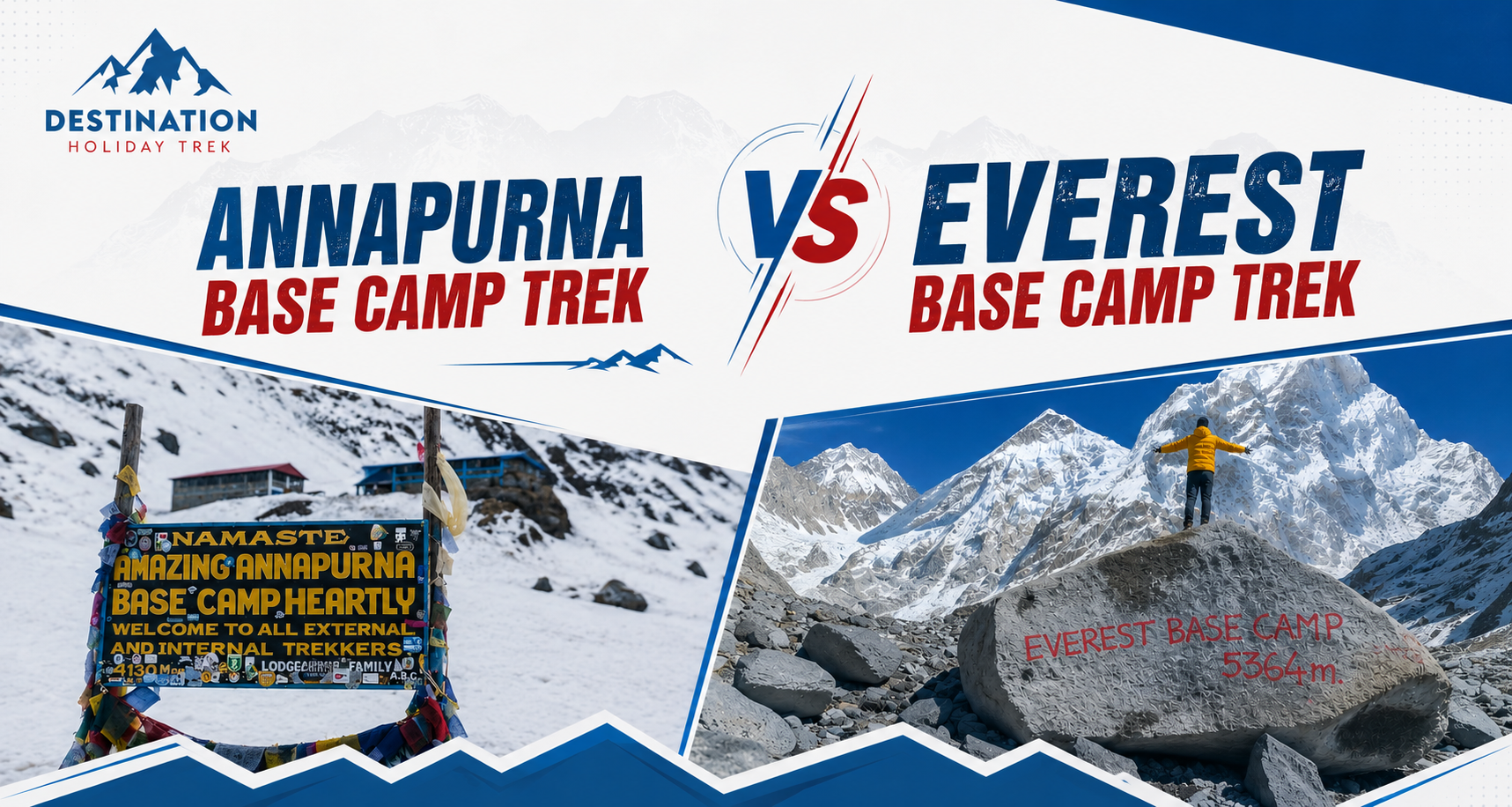
Table of Content
Introduction
Annapurna Base Camp vs Everest Base Camp Trek is a question nearly every Nepal bound trekker faces at some point, usually years before they actually book the flight. Both routes lead you into the heart of the Himalaya. Both end beneath giants. And both promise the kind of experience that stays with you long after you’re back home, scrolling through your photos and already planning the next trip.
But they are not the same trip, and choosing between them isn’t always simple. If you’re weighing Annapurna Base Camp Trek vs Everest Base Camp Trek for your 2026 adventure, this guide breaks down everything you need: difficulty, cost, duration, altitude, scenery, food, permits and more, so you can pick the trek that actually fits your fitness, budget and time.
At Destination Holiday Trek, we run both routes every season, and we’ve helped trekkers of every age and fitness level reach both base camps safely. So let’s get into the real comparison, region by region, detail by detail.
Overview of Annapurna Base Camp Trek
The Annapurna Base Camp Trek takes you into the Annapurna Sanctuary, a natural amphitheater ringed by Annapurna I, Machhapuchhre (also called Fishtail Mountain) and a wall of surrounding peaks. It begins with a short drive from Pokhara, winding through rhododendron forests, terraced farmland and Gurung and Magar villages before climbing into alpine terrain.
The Annapurna Base Camp Trek reaches a maximum altitude of 4,130 meters, roughly 1,200 meters lower than Everest Base Camp. That lower altitude means a gentler acclimatization curve and a trek that suits first time Himalayan trekkers particularly well. It’s often the trek people recommend as an introduction to high altitude walking, before attempting something more demanding like Everest Base Camp.
An Annapurna Base Camp Trek package from Pokhara typically runs 7 to 12 days depending on your itinerary, whether you include the Poon Hill sunrise viewpoint, and your pace. You can view full details and book directly through our Annapurna Base Camp Trek page.
Overview of Everest Base Camp Trek
The Everest Base Camp Trek needs almost no introduction. It’s the route that leads to the foot of the world’s tallest mountain, through the Sherpa heartland of the Khumbu region, past Namche Bazaar, Tengboche Monastery and the Khumbu Glacier, ending at Everest Base Camp itself at roughly 5,364 meters. Most itineraries also include a climb to Kala Patthar at around 5,545 meters, the classic viewpoint for sunrise over Everest.
Unlike Annapurna, the Everest Base Camp Trek begins with a short mountain flight from Kathmandu to Lukla, one of the world’s most famous airstrips. From there, trekkers follow the Dudh Koshi valley up through Sagarmatha National Park, a UNESCO World Heritage Site, gaining altitude gradually across roughly 12 to 14 days.
Because of the altitude, the flight logistics and the longer trekking days, Everest Base Camp is generally considered the harder and more committing of the two treks, and after a record breaking spring climbing season in 2026, the trail has also been busier than ever. You can explore full itinerary options on our Everest Base Camp Trek page.
Quick Comparison Table
| Feature | Annapurna Base Camp Trek | Everest Base Camp Trek |
| Region | Annapurna Conservation Area, Kaski district | Sagarmatha National Park, Solukhumbu district |
| Maximum altitude | 4,130 meters | 5,364 meters (5,545 meters at Kala Patthar) |
| Duration | 7 to 12 days | 12 to 14 days |
| Trek distance | Approximately 70 to 115 kilometers round trip | Approximately 130 kilometers round trip |
| Difficulty | Moderate | Moderate to hard |
| Starting point | Pokhara, by road | Kathmandu, by flight to Lukla |
| Transportation | Drive only, no flight required | Requires a Lukla flight |
| Altitude sickness risk | Lower | Higher |
| Best season | March to May, September to November | March to May, September to November |
| Permits required | Annapurna Conservation Area Permit | Sagarmatha National Park Permit and Khumbu Pasang Lhamu Rural Municipality Permit |
| Cost | Generally more affordable | Generally more expensive |
| Suitable for beginners | Yes, very suitable | Suitable with proper preparation |
Trek Difficulty Comparison
How hard is the Annapurna Base Camp Trek?
Annapurna Base Camp trek difficulty is generally rated moderate. The trail involves a lot of stone stairs, especially through the Ulleri and Chhomrong sections, along with steady daily ascents and descents through what locals call “Nepali flat,” terrain that constantly rises and falls rather than staying level. Daily walking typically runs 5 to 7 hours. Good general fitness is enough for most healthy adults to complete it comfortably.
How hard is the Everest Base Camp Trek?
Everest Base Camp trek difficulty sits a notch higher, largely because of the altitude rather than the terrain itself. The trail is well graded and not technically demanding, but you’re walking for 12 to 14 days at altitudes where oxygen levels are noticeably lower, and several days involve 6 to 8 hours of walking. Cardiovascular fitness, proper training beforehand and a slow, patient pace matter more here than raw strength.
In short: Annapurna tests your legs and stamina; Everest tests your lungs, patience and acclimatization strategy.
Cost Comparison
| Detail | Annapurna Base Camp Trek Cost | Everest Base Camp Trek Cost |
| Typical price range | USD 700 to USD 1,500 | USD 1,200 to USD 1,900 |
| Main cost driver | Trip length and group size | Lukla flight and higher altitude logistics |
| Luxury or upgraded options | Available, moderate price increase | Everest base camp luxury trek options cost more, often above USD 2,500 |
| Helicopter option | Not commonly needed | Everest base camp trek with helicopter return saves days but adds cost |
| Overall value | Lower cost for a full Himalayan experience | Higher cost due to flight and iconic destination |
Whichever trek you pick, always ask your operator what is included, permits, guide, porter, meals, and accommodation. Destination Holiday Trek offers clear, all inclusive pricing for both treks so there are no surprise costs on the trail.
Trek Duration & Distance
An Annapurna Base Camp trek itinerary typically spans 7 to 12 days, covering a round trip distance of roughly 70 to 115 kilometers depending on the exact route and whether you add the Poon Hill sunrise detour. Daily distances average around 8 to 15 kilometers.
An Everest Base Camp trek itinerary typically spans 12 to 14 days, covering a round trip distance of approximately 130 kilometers from Lukla. The outward journey to base camp takes longer than the return, since the itinerary is deliberately front loaded with rest and acclimatization days to protect trekkers from altitude sickness.
If your holiday time is limited, Annapurna Base Camp is the trek that fits more comfortably into a two week trip once you include arrival and departure days in Kathmandu or Pokhara.
Altitude & Acclimatization
This is the single biggest difference between the two treks. The Annapurna Base Camp trek altitude tops out at 4,130 meters, a height where altitude sickness is possible but generally milder and easier to manage with a sensible pace and proper hydration.
The Everest Base Camp trek reaches 5,364 meters, with Kala Patthar pushing even higher to around 5,545 meters. At these elevations, acute mountain sickness becomes a real and serious risk, which is why every well designed Everest itinerary builds in acclimatization days at Namche Bazaar and Dingboche. Ignoring these rest days, or ascending too quickly, is the most common reason trekkers have to turn back before reaching base camp.
If you’re unsure how your body handles altitude, Annapurna Base Camp is the safer proving ground before you commit to Everest.
Trek Route & Itinerary
A typical Annapurna Base Camp trek itinerary
A standard route begins with a drive from Pokhara to Nayapul or a nearby trailhead, then follows the trail through Tikhedhunga, Ghorepani (with an optional Poon Hill sunrise hike), Tadapani, Chhomrong, the Machhapuchhre Base Camp, and finally Annapurna Base Camp itself, before retracing the route back down, often via Jhinu Danda for a soak in the natural hot springs.
If you’d like to see the full day by day breakdown and an Annapurna Base Camp trek map, our trip page lays out the complete route.
A typical Everest Base Camp trek itinerary
A standard route begins with the flight from Kathmandu to Lukla, then follows the trail through Phakding, Namche Bazaar (with an acclimatization day), Tengboche, Dingboche (a second acclimatization day), Lobuche and Gorak Shep, from where trekkers make the final push to Everest Base Camp and typically climb Kala Patthar the following morning for sunrise views, before descending back to Lukla for the return flight.
You’ll find the complete Everest Base Camp trek itinerary and map on our Everest Base Camp Trek page.
Scenic Highlights & Mountain Views
The Annapurna Base Camp Trek delivers one of the most dramatic finales in the Himalaya. As you approach the sanctuary, the trail funnels you into a natural bowl surrounded almost entirely by an unbroken wall of peaks: Annapurna I, Annapurna South, Hiunchuli, Gangapurna and the unmistakable fishtail spire of Machhapuchhre. Along the way you’ll pass through rhododendron forest, terraced fields, bamboo groves and traditional Gurung villages, plus the optional Poon Hill viewpoint, one of Nepal’s most celebrated sunrise spots.
The Everest Base Camp Trek offers a different kind of grandeur: glaciers, the Khumbu Icefall, and views of Everest, Lhotse, Nuptse, Ama Dablam and Pumori. Namche Bazaar and Tengboche give you deep cultural immersion in Sherpa life and Buddhist monastery culture, and the sunrise from Kala Patthar over the world’s highest mountain is, for many trekkers, the single most memorable moment of any trek in Nepal.
Accommodation & Food
Both treks use teahouses, simple local lodges, instead of camping. Food on both routes is better than most people expect.
On the Annapurna Base Camp Trek, teahouses are a little more developed because of easy road access from Pokhara. Rooms are simple but comfortable, hot showers are common at lower villages, and food includes dal bhat, noodles, momos, pizza, and even bakery items in busier villages like Chhomrong and Ghorepani.
On the Everest Base Camp Trek, teahouses become more basic as you climb higher, with shared bathrooms and colder rooms above Namche Bazaar. Namche itself has bakeries, cafes, and even Wi Fi. Food quality is good throughout the Khumbu, but prices rise with altitude since everything must be carried or flown in. If you want more comfort, look at the growing number of Everest base camp luxury trek options with better rooms and heating.
Best Time to Trek
The best time to trek Everest Base Camp, and Annapurna Base Camp too, is during two seasons: spring (March to May) and autumn (September to November). These months bring clear skies, stable weather, and good mountain views, so they are also the busiest months on both trails.
Autumn, especially October and November, usually has the clearest skies of the year. Spring brings blooming rhododendrons on the Annapurna trail and slightly warmer days. Winter (December to February) is possible for experienced trekkers but brings heavy cold at high points. Monsoon season (June to August) is usually avoided on both treks because of rain and low visibility.
Permits Required
Annapurna Base Camp trek permits
Every foreign trekker needs the Annapurna Conservation Area Permit (ACAP), issued by the National Trust for Nature Conservation. It’s mandatory, checked at multiple points along the trail including Birethanti and Chhomrong, and covers your entire stay within the conservation area. Requirements around the TIMS card for Annapurna routes have shifted in recent years, so it’s worth confirming current requirements with your trekking agency before departure. Permits must be arranged in Kathmandu or Pokhara before you start walking; there’s no way to obtain them on the trail itself.
Everest Base Camp trek permits
Trekkers need two permits for the standard Lukla route: the Sagarmatha National Park Entry Permit and the Khumbu Pasang Lhamu Rural Municipality Entry Permit. Both are checked at the Monjo checkpoint. The TIMS card is generally not required for the standard Everest Base Camp route since local permits replaced it, though rules can be updated, so always check with your operator for the latest requirement before you fly to Lukla.
Destination Holiday Trek arranges all required permits for both treks as part of every package, so you can focus on the trail rather than the paperwork.
Who Should Choose Annapurna Base Camp Trek?
Annapurna Base Camp is the better choice if any of the following apply to you: it’s your first Himalayan trek and you want a gentler introduction to altitude; you have limited holiday time and want a complete Himalayan experience in under two weeks; you’re trekking on a tighter budget; you’d rather avoid the uncertainty of a Lukla flight; or you want a trek that suits families, older trekkers, or anyone with moderate rather than exceptional fitness. It’s also an excellent choice if you want maximum mountain scenery for the time and effort invested.
Who Should Choose Everest Base Camp Trek?
Everest Base Camp is the better choice if standing beneath the world’s highest mountain is a specific, non negotiable bucket list goal; you have two full weeks or more available; you’re in strong cardiovascular condition and have trained specifically for high altitude walking; you want deep immersion in Sherpa culture and Himalayan mountaineering history; or you’re comfortable with the added logistics and cost of the Lukla flight. If EBC is genuinely the dream, no other trek fully substitutes for it.
Alternative Treks
If neither classic route is quite right, Nepal offers excellent alternatives. The Annapurna Circuit Trek is a longer, more varied journey around the Annapurna massif, crossing the dramatic Thorong La Pass at 5,416 meters and passing through the arid, Tibetan influenced landscapes of Manang and Mustang. It suits trekkers who want a bigger, more diverse adventure than Annapurna Base Camp without going as high or as remote as some of Nepal’s restricted areas. You can view the full route and itinerary on our Annapurna Circuit Trek, 16 Days page.
For those who’ve already done Everest Base Camp and want a bigger challenge, the Everest Three Passes Trek links the Kongma La, Cho La and Renjo La passes, all above 5,300 meters, offering a longer, tougher and far less crowded circuit through the entire Khumbu region, including Gokyo Lakes.
Conclusion
There’s no universally “better” trek between Annapurna Base Camp and Everest Base Camp, only the trek that better fits your fitness, time and goals in 2026. Choose Annapurna Base Camp if you want a shorter, more affordable, lower altitude trek with sensational scenery and an easier logistics chain. Choose Everest Base Camp if standing at the foot of the world’s highest mountain is the specific dream you’ve been chasing, and you have the days, budget and training to commit to it properly.
Whichever route calls to you, the most important decision after choosing your trek is choosing the right team to get you there safely. At Destination Holiday Trek, our experienced guides run both the Annapurna Base Camp Trek and the Everest Base Camp Trek every season, with transparent pricing, properly arranged permits, and itineraries built around real acclimatization rather than rushed schedules.
Ready to plan your 2026 Himalayan adventure? Visit our Annapurna Base Camp Trek page or our Everest Base Camp Trek page to check dates and pricing, or explore the longer Annapurna Circuit Trek, 16 Days if you want to go further. Get in touch with our team today and let’s start planning the trek of your lifetime.
FAQs
- Which is easier, Annapurna Base Camp or Everest Base Camp?
Annapurna Base Camp is generally considered easier overall, mainly because it reaches a lower maximum altitude and requires no flight. Everest Base Camp is harder due to the higher elevation and greater altitude sickness risk. - Can a beginner do the Everest Base Camp trek?
Yes, with proper preparation. No technical climbing skills are needed, but beginners should train their cardiovascular fitness for several months beforehand and follow the itinerary’s acclimatization days carefully. - What is the Annapurna Base Camp trek cost compared to Everest Base Camp?
Annapurna Base Camp is usually more affordable, often several hundred dollars less than a comparable Everest Base Camp package, mainly because it avoids the cost of the Lukla flight. - How many days does the Everest Base Camp trek take?
Most standard Everest Base Camp trek itineraries run 12 to 14 days, including acclimatization days and the Kathmandu to Lukla flights. - Do I need a guide for either trek?
Nepal’s 2023 regulations recommend, and in many cases require, licensed guides for foreign trekkers on major routes including Annapurna and Everest. Trekking with a registered guide also significantly improves safety and navigation. - What is the best time to trek Everest Base Camp?
Spring (March to May) and autumn (September to November) are the best time to trek Everest Base Camp, offering the clearest skies and most stable weather of the year. - Is the Everest Base Camp trek with helicopter return worth it?
An Everest base camp trek with helicopter return saves several days of walking on the descent and is a good option for trekkers short on time or wanting to reduce the physical toll, though it adds noticeably to the overall cost. - What permits do I need for the Annapurna Base Camp trek?
You’ll need the Annapurna Conservation Area Permit (ACAP), arranged in Kathmandu or Pokhara before starting the trek. Your trekking agency can confirm any additional current requirements. - Which trek offers better mountain views, Annapurna or Everest?
Both are spectacular in different ways. Annapurna Base Camp offers a dramatic, close up amphitheater of peaks, while Everest Base Camp offers glaciers, the Khumbu Icefall and the world’s highest mountain itself. Neither is objectively “better,” it depends on what kind of scenery excites you most. - Can I do both treks in one trip to Nepal?
It’s possible but demanding, since together they require close to a month of trekking plus recovery time. Most trekkers choose one per visit to Nepal, often doing Annapurna first as preparation before attempting Everest Base Camp on a future trip.