- info@destinationholidaytrek.com
- +977-9768913779
- Gokarneshwor-6, Arubari, Kathmandu, Nepal


Manaslu Circuit Trek (5106 Meters)
Manaslu Circuit Trek Overview
The Manaslu Circuit Trek is one of Nepal’s most spectacular and less-crowded trekking routes, offering an authentic Himalayan adventure far from the busy trails of Everest and Annapurna. Encircling Mount Manaslu (8,163 meters)—the eighth-highest mountain in the world—this trek is renowned for its dramatic landscapes, cultural richness, and challenging high-altitude terrain.
Located in the Manaslu Conservation Area, the trek showcases extraordinary natural diversity. Trekkers journey through subtropical forests, terraced farmlands, deep river gorges, and dense pine and rhododendron forests before reaching alpine meadows and glacial valleys. As altitude increases, the scenery transforms into rugged high-mountain landscapes with breathtaking views of peaks such as Manaslu, Himalchuli, Ngadi Chuli, Ganesh Himal, and Annapurna II.
One of the major highlights of the Manaslu Circuit Trek is crossing the Larkya La Pass (5,160m)—a challenging yet rewarding high-altitude pass that offers panoramic views of snow-covered mountains and glaciers. This makes the trek ideal for experienced trekkers seeking adventure, solitude, and raw Himalayan beauty.
Culturally, the trek is equally enriching. The trail passes through remote villages such as Samagaun, Samdo, and Lho, where ancient monasteries, mani walls, prayer flags, and chortens reflect strong Tibetan Buddhist influences. The region’s unique traditions, architecture, and warm hospitality provide trekkers with deep cultural immersion rarely found on more commercial routes.
Due to its restricted area status, the Manaslu Circuit Trek requires special permits and must be completed with a licensed guide, helping preserve the region’s natural environment and cultural heritage. This regulation also ensures fewer trekkers on the trail, making it a perfect choice for those looking for a peaceful, off-the-beaten-path trekking experience in Nepal.
Overall, the Manaslu Circuit Trek combines adventure, culture, and pristine mountain scenery, making it one of the finest long-distance treks in the Himalayas.
Why Choose the Manaslu Circuit Trek?
• Off-the-Beaten-Path: Less crowded than Everest and Annapurna treks, offering a more serene experience.
• Mountain Views: Close-up views of Mount Manaslu, Himalchuli, Ngadi Chuli, and Ganesh Himal.
• Cultural Immersion: Visit ancient Buddhist monasteries, quaint villages, and experience Tibetan culture.
• High-altitude Challenge: Traverse the Larkya La Pass (5,160m) for breathtaking panoramas.
• Varied Terrain: Pass through lush forests, river valleys, and high-altitude deserts.
• Remote Adventure: A less commercialized, authentic trekking experience.•
Manaslu Circuit Trek Highlights
★ Mount Manaslu (8,163m) – The Spirit Mountain
Experience awe-inspiring views of Mount Manaslu, the eighth-highest mountain in the world. Throughout the trek, you’ll witness dramatic panoramas of snow-covered peaks, glaciers, and ridgelines, especially from villages like Lho and Samagaun, where Manaslu dominates the skyline.
★ Larkya La Pass (5,160m) – A High-Altitude Adventure
Cross the legendary Larkya La Pass, the highest point of the Manaslu Circuit Trek. This challenging yet rewarding ascent offers 360-degree panoramic views of Manaslu, Himalchuli, Cheo Himal, Kang Guru, and Annapurna II, making it one of the most scenic high passes in Nepal.
★ Rich Buddhist & Tibetan Culture
Explore centuries-old Buddhist monasteries, chortens, mani walls, and prayer wheels that line the trail. Visit traditional Tibetan-influenced villages such as Samagaun, Samdo, and Lho, where daily life, architecture, and festivals reflect deep Himalayan Buddhist traditions.
Manaslu Circuit Trek – Information Guide
Region:
Manaslu Region, Nepal
Duration:
14–18 days
(The length depends on walking pace and acclimatization days)
Difficulty Level:
Moderate to Challenging
Good physical fitness is required. Previous trekking experience is helpful, especially for high altitude.
Maximum Altitude:
5,160 meters
(Larkya La Pass – the highest point of the trek)
Trek Style:
Tea House (Lodge) Trek
You stay in local lodges along the trail, similar to the Everest Base Camp trek.
Meals:
Simple and nutritious meals are served during the trek, including:
Dal Bhat (rice, lentils, vegetables)
Tibetan bread and soups
Noodles, rice, and seasonal vegetables
Group Size:
1–15 people
Small groups allow better safety and a comfortable trekking pace.
Accommodation:
Local tea houses and lodges
Rooms are basic but comfortable. Most have shared bathrooms.
Best Time to Trek
Spring (March – May):
Warm weather, clear skies, and blooming flowers.
Autumn (September – November):
Best season for trekking with stable weather and clear mountain views.
Permit Requirements for Manaslu Circuit Trek
You’ll need to obtain the following permits for the
1. Manaslu Circuit Trek:
Manaslu Restricted Area Permit (RAP)
This permit is required because the Manaslu region is a restricted area.
It can only be obtained through a registered trekking agency.
2. Manaslu Conservation Area Project (MCAP) Permit
A fee that helps conserve the area’s biodiversity.
3. Annapurna Conservation Area Permit (ACAP)
Required for passing through the Annapurna region if you take the route via Besi Sahar.
ITINEARY
Welcome at Tribhuvan International Airport and transfer to your hotel. Meet your guide for a trek briefing and equipment check. Explore Thamel or enjoy a welcome dinner.
Overnight: Hotel in Kathmandu
Morning: Drive from Kathmandu to Soti Khola (7-8 hours, 140km).
Route: The drive takes you along the Prithvi Highway to Dhading, passing through the scenic Trishuli River valley. The road is rough in some areas, but the journey offers great views of the surrounding mountains.
Overnight: Stay in a local lodge at Soti Khola.
Route: The trek begins with a gentle walk, passing through forests and small villages. Cross several suspension bridges over the Budi Gandaki River, and climb up and down the trail to reach Machha Khola.
Overnight: Stay in a lodge in Machha Khola.
Route: After crossing the Machha Khola River, continue through terraced fields and small villages like Khorlabesi and Dumre. Cross suspension bridges, and follow a river gorge to reach Jagat, a small village.
Overnight: Stay in a lodge at Jagat.
Route: The trail gradually ascends, passing through the Budi Gandaki River valley. You'll walk through dense forests, cross several small villages like Philim and Ekle Bhatti, and head towards Deng, a Tibetan-influenced village.
Overnight: Stay in a lodge in Deng.
Route: The trail continues to climb through a forested landscape. You’ll pass through Bihi Phedi and Namrung. Namrung offers beautiful views of Manaslu, Himalchuli, and Ngadi Chuli.
Overnight: Stay in a lodge in Namrung.
Route: The trail ascends steeply to Samagaun, passing through villages like Lho and Shyala. The view of Manaslu from Lho is stunning. As you approach Samagaun, you'll notice the increasing Tibetan influence.
Overnight: Stay in a lodge at Samagaun.
Activities: Take a rest day in Samagaun for proper acclimatization. You can visit the Manaslu Base Camp or hike to Pungyen Monastery for a beautiful view of Manaslu and the glaciers.
Overnight: Stay in Samagaun.
Route: A short but steep trek to Samdo, one of the highest villages in the region. As you approach Samdo, you’ll get your first glimpse of the Larkya La Pass.
Overnight: Stay in a lodge at Samdo.
Activities: This day is important for acclimatization. You can hike to the nearby Buddhist Monastery or visit Larkya Glacier for better views of the mountains.
Overnight: Stay in Samdo.
Route: The trail leads towards Dharamsala (also called Larkya Phedi), which lies at the base of the Larkya La Pass. The route is gradually ascending, and you will start noticing the high-altitude desert-like terrain.
Overnight: Stay in a lodge at Dharamsala.
Route: The toughest and most exciting day of the trek. You'll start early to cross Larkya La Pass (5,160m). The pass offers panoramic views of Manaslu, Himalchuli, Ngadi Chuli, and other peaks. After the pass, descend steeply to Bimtang, passing through alpine meadows.
Overnight: Stay in a lodge at Bimtang.
Route: The trail descends through a forested area towards Gho, a small village. You'll cross several rivers and see lush landscapes as you make your way down.
Overnight: Stay in a lodge in Gho.
Route: Continue descending through forests and past Sirdibas and Philim villages. The trail leads to Tal, a beautiful village located by the Marsyangdi River.
Overnight: Stay in a lodge at Tal.
Route: A further descent brings you to Syange, passing through Chamje and other villages. This is the last day of trekking before returning to Kathmandu.
Overnight: Stay in a lodge at Syange.
Route: Drive back to Kathmandu from Syange, retracing the road back to the capital. The drive takes about 7-8 hours, and you'll pass through beautiful landscapes and rivers along the way.
Overnight: Stay in a hotel in Kathmandu.
Activities: Relax in Kathmandu, enjoy some sightseeing, or do some last-minute shopping. You can visit popular sites like Swayambhunath Stupa (Monkey Temple) or Boudhanath Stupa.
Overnight: Stay in Kathmandu.
Activities: Transfer to the airport for your flight back home or onwards to your next destination.
Cost Includes
✅ Airport Transfers
Private pick-up and drop-off service at Tribhuvan International Airport (TIA), Kathmandu.
Assistance with luggage and smooth transfers between the airport and your hotel.
✅ Domestic Transportation
Round-trip transportation between Kathmandu and Soti Khola (or an alternative starting/ending point in the Manaslu region) by private jeep or public bus, depending on road conditions and itinerary.
All necessary ground transfers as outlined in the trek schedule.
✅ Accommodation
Kathmandu:
3 nights accommodation in a comfortable 3–4 star hotel on a Bed & Breakfast (B/B) basis.
Rooms with private bathrooms (where available), Wi-Fi, and hot showers.
During the Trek:
Twin-sharing teahouse or lodge accommodation throughout the Manaslu Circuit Trek.
Clean, basic rooms with shared facilities in higher altitudes.
✅ Meals
During the Trek:
Full board meals including breakfast, lunch, and dinner served at local teahouses/lodges.
A variety of meals such as local Nepali dishes (Dal Bhat), Tibetan bread, noodles, soups, pasta, rice, vegetables, tea, and coffee.
In Kathmandu:
Daily breakfast included at the hotel.
✅ Professional Trekking Staff
Licensed, experienced, and English-speaking trekking guide certified by the Nepal government.
Porter service:
1 porter for every 2 trekkers, carrying up to 20–25 kg total weight.
All staff expenses included (salary, meals, accommodation, insurance, equipment, and transportation).
✅ Permits and Government Fees
Manaslu Conservation Area Permit (MCAP).
Trekking Information Management System (TIMS) Card.
Special Restricted Area Permit for Manaslu (mandatory for trekking in the region).
All government taxes and service charges.
✅ Transportation in Kathmandu
Private or shared ground transportation in Kathmandu for airport transfers, hotel transfers, and pre/post-trek sightseeing (as per itinerary).
✅ Trekking Equipment & Logistic Support
Trekking staff assistance with luggage handling, route navigation, and safety support.
Use of trekking poles, ropes, and other essential group equipment if required.
Duffel bag provided for trekking (refundable after the trek).
✅ Medical & Emergency Support
Comprehensive first-aid kit carried by the trekking guide.
Basic medical assistance for altitude sickness, injuries, or minor illnesses.
Emergency coordination support in case of evacuation (helicopter rescue cost not included).
COST EXCLUDES
❌ International Flights:
Flights to and from Nepal are not included.
❌ Nepal Visa Fee:
The visa fee for entering Nepal is not included in the cost.
❌ Travel/Trekking Insurance:
Travel insurance and high-altitude rescue coverage are not included. Adequate insurance is required for the trek.
❌ Personal Trekking Gear:
Trekking gear such as boots, trekking poles, sleeping bag, jackets, and other personal equipment are not included.
❌ Personal Expenses:
Drinks (bottled water, soda, alcohol) and snacks are not included in the package price.
❌ Emergency Evacuation Costs:
Emergency evacuation costs, if required, are not included.
❌ Tips for Staff:
Tips for the guide, porter, driver, and other staff are not included and are at your discretion.
MAPE
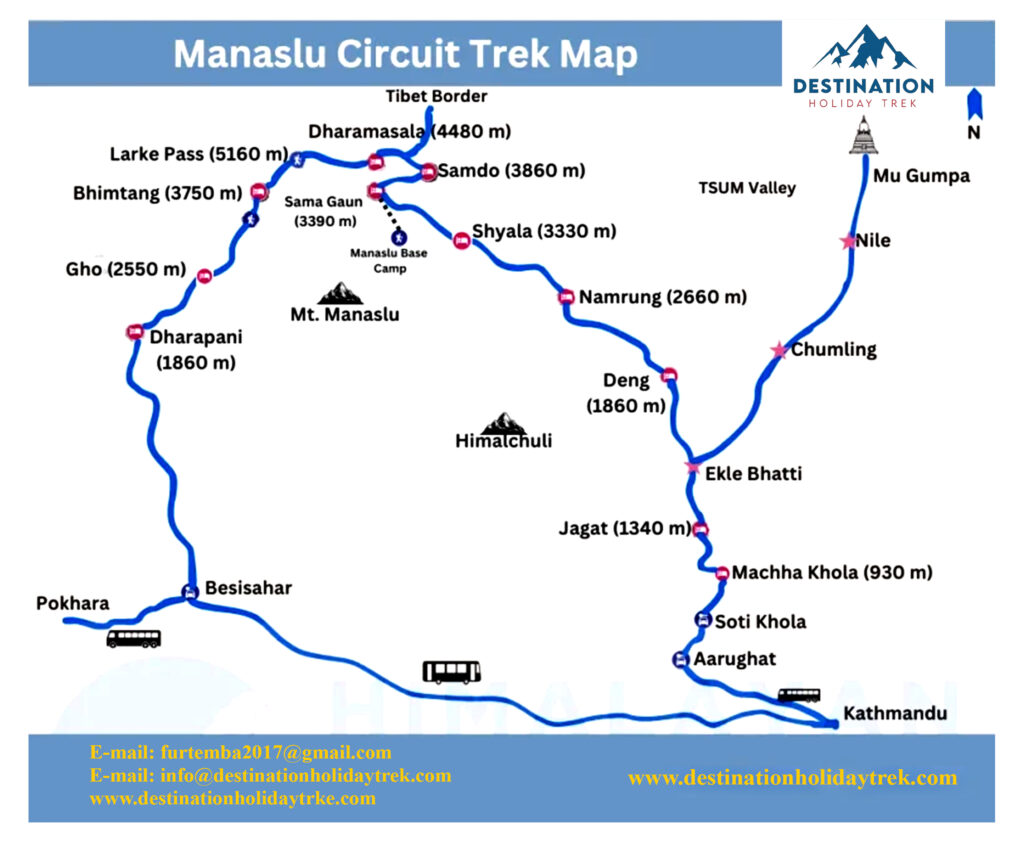
MANASLU CIRCUIT TREK – FAQ
Q1: Best Time to Trek?
A: Pre-monsoon (March–May) and post-monsoon (September–November) for clear skies, mild temperatures, and stunning mountain views.
Q2: Trek Difficulty?
A: Moderate to challenging. This trek requires good fitness levels, with some technical sections and high-altitude crossings. Acclimatization days help minimize altitude sickness risks.
Q3: Trek Duration?
A: Typically 14–16 days, including flights, trekking, acclimatization, and return to Kathmandu.
Q4: Highest Point?
A: Larkya La Pass (5,160m) offers breathtaking views and is the highest point on the trek.
Q5: Previous Experience Needed?
A: No prior trekking experience is required, but a reasonable level of fitness and stamina is recommended for the trek’s physical demands.
Q6: How to Start the Trek?
A: Begin with a scenic drive or flight from Kathmandu to Soti Khola, where the trekking officially starts.
Q7: Accommodation?
A: Teahouses and basic lodges with essential amenities are available throughout the trek, offering a warm and comfortable environment.
Q8: Meals Provided?
A: Yes, teahouses provide Nepali and Western meals, hot drinks, and snacks. Dietary options are available with prior notice.
Q9: Guides & Porters?
A: Experienced guides, including local Sherpas, and porters are provided for support and safety during the trek.
Q10: Safe for First-Timers?
A: Yes, with proper guidance, acclimatization days, and support. However, the trek’s higher altitude and challenging terrain require good preparation.
Q11: What to Pack?
A: Essential items include warm clothing (layers), trekking boots, sleeping bag, trekking poles, sunscreen, water bottle, and a personal first aid kit. You may also need a good headlamp and a daypack.
Q12: Mobile & Internet?
A: Mobile coverage and Wi-Fi are available in some teahouses, but connectivity becomes sparse as you trek higher into remote areas.
Q13: Altitude Sickness?
A: Altitude sickness is a risk, especially at higher elevations. Guides are trained in its prevention and management. Proper acclimatization and staying hydrated are crucial.
Q14: Physical Preparation?
A: Cardiovascular exercise, hiking, and stair climbing 2–3 months before the trek are ideal for building stamina and strength for the trek’s demanding terrain and altitude.
Trek Cancellation & Refund Policy
At Destination Holiday Trek, we are committed to providing transparent, fair, and professional trekking and adventure travel services in Nepal. This Trek Cancellation and Refund Policy outlines the terms and conditions for cancelling trekking packages, refund eligibility, and booking modifications for all trekking and circuit routes. By booking any trekking or expedition package with us, you agree to the cancellation and refund terms stated below.
Nepal Trekking & Circuit Trek Cancellation Policy
This cancellation policy applies to all trekking and circuit trekking packages organized by Destination Holiday Trek, including but not limited to:
Everest Base Camp Trek
Annapurna Base Camp Trek
Annapurna Circuit Trek
Manaslu Circuit Trek
Langtang Valley Trek
Upper Mustang Trek
Remote and customized trekking itineraries
✅ Free Trek Cancellation in Nepal
Trekkers may cancel their trekking booking up to 30 days before the official trek departure date without cancellation charges.
Refund Terms:
Full refund of advance payment (excluding non-refundable service and transaction charges)
Bank transfer, payment gateway, or currency conversion fees are non-refundable
This flexible cancellation policy allows trekkers to confidently plan their Himalayan trekking adventure.
Trek Cancellation Charges
If a trekking or circuit trek is cancelled within the following timeframe, cancellation charges will apply:
20 Days Before Trek Start Date
→ 25% of the total trek package cost will be charged.
10 Days Before Trek Start Date
→ 50% of the total trek package cost will be charged.
1–9 Days Before Trek Start Date
→ 75% of the total trek package cost will be charged.
These charges apply because trekking permits, accommodations, transportation, and guide and porter arrangements are confirmed in advance.
No-Show, Late Arrival & Early Trek Departure Policy
Destination Holiday Trek does not provide refunds, credits, or compensation in the following situations:
Failure to join the trek on the scheduled departure date
Early departure or voluntary withdrawal during trekking
Missed trekking days due to illness, injury, or personal reasons
Domestic or international flight delays and cancellations
Transportation disruptions or itinerary changes due to personal reasons
Failure to obtain necessary travel documents, permits, or insurance
This policy applies to all trekking routes and circuit treks in Nepal.
Non-Refundable Trekking Expenses
Certain trekking costs are prepaid to government authorities and third-party service providers. These expenses are strictly non-refundable once confirmed, including:
National park and conservation area permits
TIMS (Trekkers’ Information Management System) card
Restricted area permits (if applicable)
Domestic flights and transportation bookings
Accommodation and lodge reservations
Trekking guides, porters, and support staff services
Payment gateway and banking transaction fees
Trek Cancellation Request Procedure
To cancel a trekking booking, trekkers must submit cancellation requests through:
Official company email
Written cancellation request
The official cancellation date will be considered the date Destination Holiday Trek receives the written request.
Refund Processing Time
Approved refunds will be processed within 7 to 14 business days
Refunds will be issued through the original payment method unless otherwise agreed
Banking and transfer fees will be deducted from the refundable amount
Force Majeure & Uncontrollable Circumstances
Destination Holiday Trek is not responsible for trek cancellations, delays, or itinerary changes caused by events beyond company control, including:
Severe weather conditions or flight cancellations
Natural disasters such as earthquakes, landslides, floods, or avalanches
Government restrictions or political instability
Pandemics or public health emergencies
Strikes, road blockages, or transportation disruptions
In such cases, we will attempt to provide alternative trekking arrangements, rescheduling options, or itinerary adjustments when possible.
Travel Insurance Requirement for Trekking in Nepal
All trekkers are strongly advised to obtain comprehensive travel and high-altitude trekking insurance covering:
Trip cancellation and interruption
Emergency helicopter evacuation
Medical treatment and hospitalization
Personal accident and loss of belongings
Destination Holiday Trek will not be responsible for financial losses caused by lack of adequate insurance coverage.
Legal Jurisdiction & Policy Agreement
By booking any trekking or circuit trekking package with Destination Holiday Trek, clients confirm they have read, understood, and accepted this cancellation policy. All trekking agreements are governed by the laws of Nepal, and any disputes shall be handled under Nepalese legal jurisdiction